

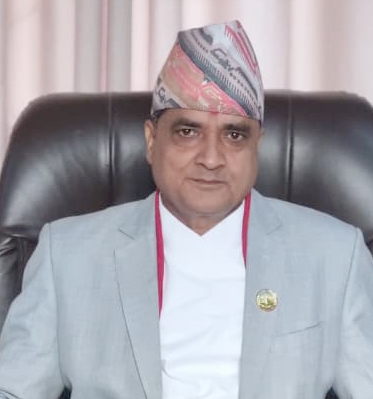
The Lumbini Province Government is currently facilitating various agencies and sectors to implement the province’s policies, plans, budgets, and programs. What kinds of human-rights-friendly and citizen-oriented policies, programs, and budgets has the provincial government formulated? How is the province ensuring effective implementation? How do policies, plans, programs, and budgets include residents who have not yet been fully integrated into the mainstream of the state? How have the foundations been laid for policies, programs, and budgets that foster a culture of human rights?
Below is part of a conversation on these topics between Rima BC, INSEC Rupandehi representative, and Janmajaya Timilsina, the Minister for Social Development of Lumbini Province.
What are the Priority Areas of the Province Government’s Plans, Policies, and Budget?
The provincial government has been working on plans and programs to address diverse social and developmental needs. Key priorities include promoting women’s rights, implementing programs to end child marriage, achieving full literacy across the province, and improving the overall quality of education. Special emphasis is placed on integrating modern technologies, running awareness campaigns against human trafficking, and ensuring accessibility for persons with disabilities. Additionally, targeted initiatives are being developed to uplift marginalized and Dalit communities. Notably, the Dalit Law has already been endorsed at the ministry level and forwarded to the Office of the Chief Minister, where it is currently under review for higher legislative approval.
How have marginalized groups, communities, and gender diversities been addressed in the province’s plans, policies, programs, and budget?
The province government has been working with sensitivity to bring marginalized communities into the mainstream. For this, Rs 750,00,000 has been allocated to strengthen the Innovation Center. Programs have been introduced such as scholarships for freed bonded laborers, scholarships for girls studying science, and other educational incentives. The province has also prioritized the country’s oldest technical university. When I took office, there were only 33 students enrolled, but now the number has grown to nearly 400. There are also programs to encourage and support teachers. In addition, special focus has been given to the Tharu and Muslim communities, persons with disabilities, minority groups, and freed bonded laborers. The province government has also launched the slogan encouraging women of Lumbini Province to take the lead in business and entrepreneurship.
The province government has many policies, plans, and programs. How easy do you see their implementation?
We have carefully reviewed and discussed past policies and their implementation to learn from experience. We are coordinating with different offices and local governments to ensure smooth execution and are working to strengthen collaboration. We have also discussed how to continue past learnings and improve gaps. The Chief Minister has instructed all ministries to work sensitively so that citizens feel the impact of the provincial government. Accordingly, we have taken steps forward. Students will not be without books or study materials. We are working to promote both education and self-employment. Just this week, six students from the province were recommended for full scholarships to study at Tribhuvan University.
What do you think are at least five main achievements that residents of the province noticed after you became the Minister of Social Development?
We have created a more organized system for managing employees. Earlier, there was little attention to where employees were assigned or what tasks they were doing. Now, I inform the Secretary about my activities, and the Secretary and other staff also keep everyone updated. We have stopped making plans arbitrarily. By introducing a Program Implementation Directive, we now prepare policies, plans, programs, and budgets in a clear and structured way. We have passed the Dalit Rights Act to fully protect the rights of the Dalit community. We have worked with Muslim leaders and local governments to improve access to education for Muslim women. We have also worked to remove social problems and promote good governance through these efforts.
There are accusations that the provincial government has become unnecessary, overly expensive, and that the rich are getting richer while the poor are getting poorer, what do you have to say about that?
While the provincial government is indeed costly, the claim is not true. Previous governments at provincial level never managed to establish proper systems. However, it is not correct to say that nothing has been done. The provincial government has distributed scholarships worth over Rs 7,50,00,000 to students. It has also carried out many other initiatives. There is not a single rural municipality in the country without a motorable road. Without the federal system, this would not have been possible through the central government alone. There is a common mindset that the government should provide everything and that citizens only need to ask. This needs to change. The government can only provide what it has in its resources. Many improvements have already taken place. In the past, people had to walk five hours just to get a phone line in remote areas, but now conditions have improved. There may be some issues that remain as the provinces have not been given full authority, and lack sufficient resources. Once the province is fully empowered and properly equipped, ordinary citizens will truly appreciate the importance and necessity of the provincial government.
What initiatives have been taken to prevent youth from going abroad for employment and to create an environment for work within the country?
We have been developing Lumbini Technical University as a flagship project with the aim of helping young people learn skills and create employment opportunities within the country. We have created an environment where youth can gain knowledge, develop skills, and connect their learning directly with job opportunities. Currently, we are focusing on producing skilled manpower and human resources, and linking this work with tourism, industry, and employment opportunities. There has been a misconception that everything is available abroad. The government has implemented various youth self-employment and entrepreneurship programs to show that opportunities exist within the country. Local governments have also been running different youth-focused programs and skill-based training. The provincial government is committed to campaigns that teach skills to youth and make them self-reliant, encouraging them to build their future at home rather than seeking opportunities abroad.
What is the accountability of the provincial government in ensuring that citizens feel its presence?
The provincial government is always there to serve its citizens and always works in their best interest. Building a prosperous Lumbini Province requires a shared vision and collaborative effort development cannot happen through opposition alone. Lumbini Province is rich in diversity and potential, and making it a better place requires positive contributions from everyone. Fostering a culture of constructive thinking will enable significant leaps in development. To achieve this, citizens are encouraged to provide both constructive and critical feedback to the provincial government. The government remains attentive and responsive to the rights and needs of its people. This, perhaps, defines the essence of our accountability.