

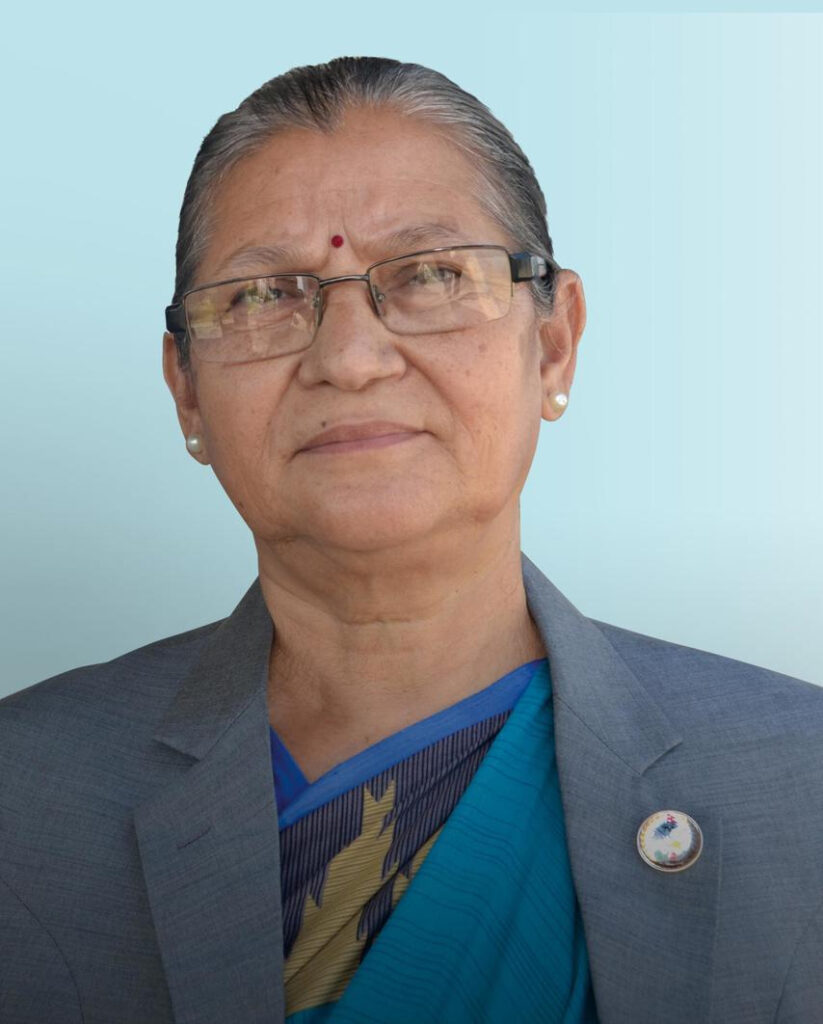
Ashtalakshmi Shakya is the Vice-Chairperson of the CPN (UML). Having played a significant role in Nepal’s political movements, Shakya has also served as the Chief Minister of Bagmati Province. For Prachi, INSEC Bagmati Province Coordinator Ganesh Bhandari conducted an interview with her on topics such as the women’s movement in Nepal, parliamentary politics, and the challenges in achieving women’s rights. We present an excerpt from that discussion.
How did your political journey begin?
My life’s journey began in a traditional Newar family in Kathmandu. During my childhood, I closely observed the deep social structures and the role of women within them. Our society was male-dominated; women’s voices were seldom heard, and their presence in decision-making processes was almost unimaginable. Despite these circumstances, I had a strong interest in education. Even though I was fortunate to have access to schooling, I often felt the need to challenge the restrictive environment around me. From my school days, I began raising questions about social inequalities. Over time, this interest gradually transformed into political awareness. During the 1979 AD People’s Movement, political consciousness was spreading across the country. At that time, I was a teacher. However, teaching alone did not satisfy me. I realized that to bring about real change, one cannot merely impart knowledge; one must actively engage in transforming society. Therefore, I decided to leave my teaching job and devote myself fully to politics. At that time, it was a bold and risky choice for a woman to enter politics. That decision changed the entire direction of my life.
What were the challenges of underground politics?
Underground politics was not simply going out and distributing leaflets. It was a form of ideological discipline. I abandoned my real name, identity, and all personal recognition. I never had a permanent address, sometimes in Chitwan, sometimes in Jhapa, at other times in Ilam or Biratnagar. We stayed in comrades’ houses, but we could never feel completely safe. Life underground was even more difficult for women as there was a lack of hygiene during menstruation, an absence of medical care for health issues, and harsh societal judgment. During my time underground, I focused particularly on raising women’s consciousness, building organizations, and providing training. My priority was to bring women into politics, helping them step out of roles confined to the household. I held secret meetings in rural municipalities, ran awareness campaigns, and nurtured new leadership faces. In 2045 BS, I was arrested in Ilam. That became a decisive turning point for me. While in jail, I conducted self-reflection, considering where I was, why I was there, and what changes I wanted to bring. There, I not only learned political rigor but also began to deeply understand serious human rights issues. The days I spent in jail helped me mature ideologically.
How did you enter parliamentary politics?
Transitioning from underground politics to parliamentary politics meant channeling the movement into an institutional path. After the 1991 general elections, I was elected as a member of the National Assembly. At that time, women leaders in parliament could be counted on one hand. That responsibility gave me not only an opportunity but also a serious duty. In parliament, I consistently raised my voice on issues concerning women, workers, Dalits, and indigenous communities. In 1998, I was elected as a Member of the House of Representatives from Kathmandu-5. The Maoist movement was at its peak, which significantly impacted mainstream politics. However, we believed in the potential for change through democratic practice. In subsequent elections, I continued to advance by taking on various responsibilities within my party. In 2018, I was directly elected as a provincial assembly member from Bagmati Province.
It is said that your journey to becoming Chief Minister was not easy. Is that true?
Yes, it was not easy. Competition within the party is natural, but as a woman leader, I faced unnecessary questions such as, “Can she lead?” or “Can she manage?” Plans were even made within the parliamentary party to sideline me. Initially, it seemed that Chairperson Oli did not fully support me either. However, in the end, the party leadership made the decision and entrusted me with the responsibility of becoming the first Chief Minister of Bagmati Province. This was not just my personal victory; it was a recognition of women’s leadership capabilities.
As Chief Minister, what kind of work did you undertake?
When I became Chief Minister, federalism was just starting, and the system was still new. I was determined to make Bagmati Province a model of good governance and development. To achieve this, I launched a literacy program that helped improve education across the province. I also set up the Provincial Policy and Planning Commission to create development plans in a scientific and organized way. Government committees for public hearings were strengthened and structured properly. We worked to improve coordination between the provincial and local governments, and public interest was considered when prioritizing development projects. I aimed to introduce programs specifically for women, children, people with disabilities, and marginalized communities, though time was limited. Internal party conflicts sometimes affected stability. Despite the challenges, I believe I showed that women can lead effectively and make a real impact in policy-making.
You have been active in women’s rights and political participation for a long time. How do you reflect on the work you have done for change?
I led efforts to institutionalize women’s issues within the policies and documents of the UML party. At the eighth general convention, I raised issues such as gender equality, women’s property rights, ending violence against women, maternity protection, and women workers’ rights, and successfully included them in the party documents. Later, these documents served as a basis for provisions in the Constitution. I also championed the slogan: “One family, two property rights: both husband and wife should have their names on assets”. I have always believed in women’s self-reliance and decision-making abilities. That is why I have continued working in areas such as women’s cooperatives, self-employment, and leadership development.
What is the current situation of women’s participation?
In parliament, most women are there through proportional representation, while very few are directly elected. Political parties are often reluctant to give women important responsibilities, and women rarely get the chance to prove their leadership skills. Sadly, some women leaders also struggle to accept the leadership of other women. I am not in a direct executive position right now, but I want to share my experience, ideas, and guidance with the next generation. Through the Motidevi Memorial Center, I am working to develop women’s leadership, provide political training, promote entrepreneurship, and encourage social change. Going forward, my focus will be on mentoring, guiding, and supporting women leaders.