

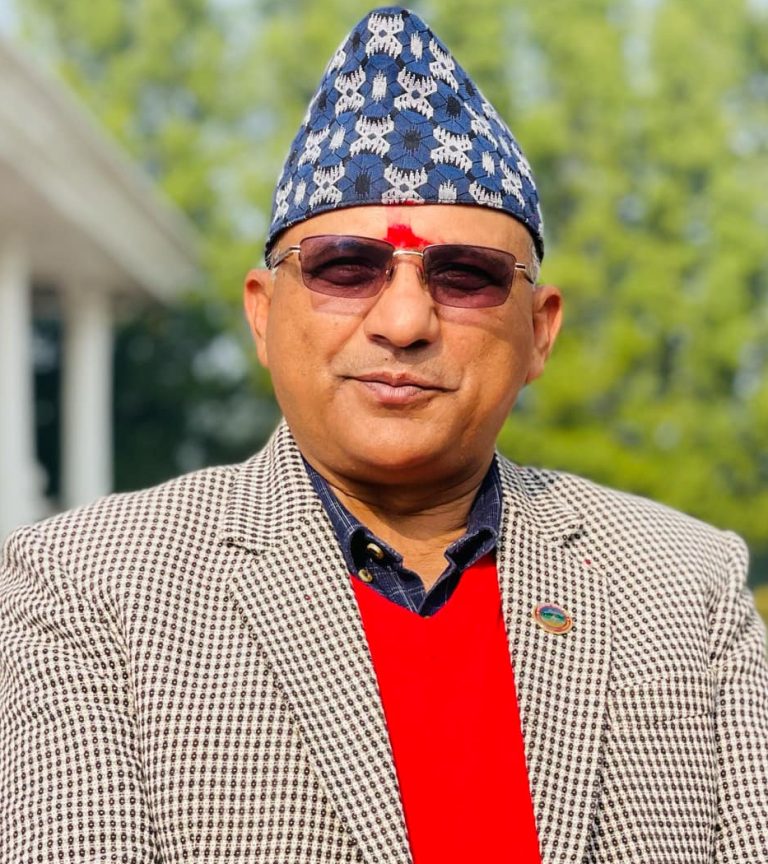
As the Lumbini Provincial Government engages in the formulation of its policies, plans, programs, and budget, INSEC representative Rima BC spoke with Minister for Physical Infrastructure Development, Bhumishwor Dhakal, to discuss the government’s commitment to environment-friendly approaches. Given below is a part of the conversation between INSEC representative Rima BC and Minister for Physical Infrastructure Development, Bhumishwor Dhakal :
Is the Lumbini Provincial Government currently in the process of formulating its policies, plans, programs, and budget? What approach is being taken to ensure the policies and budget are environmental friendly?
The provincial government is currently in the process of formulating its policies, plans, and programs. As the Minister of Physical Infrastructure and Urban Development, I am responsible for ensuring these frameworks are environment friendly and effectively meet the needs of citizens. We remain committed to advancing infrastructure development while safeguarding the environment. Before working on physical infrastructure, we have carried out initial environmental tests and impact assessments. Likewise, during energy projects, we use skilled workers to protect the environment by reducing harmful emissions. We also focus on preserving green areas and biodiversity, involve local people, raise their awareness about the environment, and encourage their active participation in all projects, big and small. Similarly, during the implementation of projects, we ensure that the projects do not harm the environment. We manage waste by separating recyclable and non-recyclable materials, check whether laws exist for proper disposal, and work on solutions accordingly. If laws are missing, we take initiatives to create them. We also conduct monitoring, evaluation, and inspection. While developing physical infrastructure, we focus on protecting the environment. Currently, since wetland areas are at risk of destruction, we prioritize environmentally friendly physical development to protect these areas as we move forward.
What kinds of policies, plans, programs, and budgets will the provincial government prioritize in the coming days?
Physical infrastructure development is the backbone of development. We are advancing programs that raise people’s living standards and encourage farmers to increase production, connect their products directly to the market, and eliminate middlemen’s interference to empower farmers as the rightful owners. We prioritize and implement these policies and programs with full commitment.
People complain that the government has focused mainly on physical infrastructure development but neglected human development. You say physical infrastructure is the backbone of development, Can development focused solely on physical infrastructure be truly meaningful if it overlooks human development?
We have reviewed the projects and activities carried out in the past. Due to the implementation of small and scattered plans in previous years, the outcomes were limited and often not visible. That’s why, this year, we are working to develop a master plan for physical infrastructure development. In the past, the state built roads, but when they were damaged, it couldn’t manage timely repairs, and the public wasn’t fully involved. Now, we are identifying needs by engaging directly with the people, and our policies and programs are designed to make them equally responsible and accountable. As the Minister for Physical Infrastructure Development,it is my priority to lie in infrastructure development. However, that does not mean the provincial government has ignored human development. We are equally focused on advancing both, and we are working to ensure broader public participation in the process. The provincial government is moving forward with this approach. You can be assured of that.
There have been complaints that coordination among the provincial government’s ministries is very weak. Is the coordination between ministries in the province really as weak as reported?
The provincial government is preparing a provincial master plan. We are coordinating with ministries such as the Ministry of Agriculture, Land and Cooperatives; the Ministry of Energy, Water Resources and Irrigation; and the Ministry of Industry, Tourism and Transport to connect farmers’ production and medicinal herbs to the market, promote tourism, and address water and irrigation needs. In some places with strong tourism potential but no road access, we are holding discussions on how to expand road connectivity and are moving forward based on those discussions.
What kinds of plans are being developed to bring communities that have been left out of the state’s mainstream such as women, Dalits, Madhesi, Muslims, minorities, marginalized groups, and persons with disabilities into the mainstream?
We are preparing policies and programs to include communities that have been left behind those without access to education and healthcare so they feel that the plans belong to them. Our approach is gender-friendly, disability-friendly, human rights-friendly, and environmentally friendly. Although we have a small budget and limited resources, public expectations are growing. That’s why we are working carefully to make the best use of what we have and focus on how to bring these communities into the mainstream. We are also paying attention to what people really need and how our efforts can benefit them and help them feel connected to the state.
There are accusations that the provincial government has become unnecessary, overly expensive, and a center for recruiting party workers. How do you justify the relevance of the provincial government?
It has been eight years since the country adopted a federal structure. During this time, development in the province has taken a new direction. Over this period, more than 160 large and small bridges have been constructed, over 1,400 kilometers of roads have been constructed, more than 50 suspension bridges have been built, and the quality of roads has improved. All of this has been possible because of the provincial government. Such development was not fully possible through the federal government alone. Having the province’s own citizens serving as Chief Minister, ministers, and secretaries has made the work easier. Marginalized communities including women, children, Dalits, marginalized groups, Madhesi, Muslims, persons with disabilities, gender and minority communities, and senior citizens have been able to come to the province and raise their demands. They have had direct opportunities to speak with the concerned ministers. All of this has been possible because of the provincial government. It was not easy to raise these issues with the federal government. If employee laws, education laws, financial federalism, and administrative federalism were entrusted to the provincial government, the pace of development could have advanced even further.
How does the provincial government ensure that the people truly feel its presence and what is its accountability to the residents of the province?
We are currently running the government through a coalition of the two major parties. The Chief Minister is deeply concerned about issues directly affecting people’s lives. The financially strained federal government is sending us a reduced budget, so our budget size is small. Even with this limited budget, we will identify the province’s needs, formulate policies and programs accordingly, and implement them. The provincial government will move forward by recognizing citizens’ needs and prioritizing them. We are currently in the stage of drafting policies, plans, programs, and budgets. If the residents of the province have any suggestions, I kindly invite you to share them through Inseconline so that we can include them in our policies and programs. I would like to express my gratitude to INSEC for providing this opportunity. The provincial government is always with the citizens and residents of the province whenever they need support. We are sensitive to protecting all castes, religions, genders, and communities in the province. It is the state’s responsibility to safeguard the fundamental human rights of its citizens, and we are capable of fulfilling this responsibility. Perhaps this is the essence of our accountability.