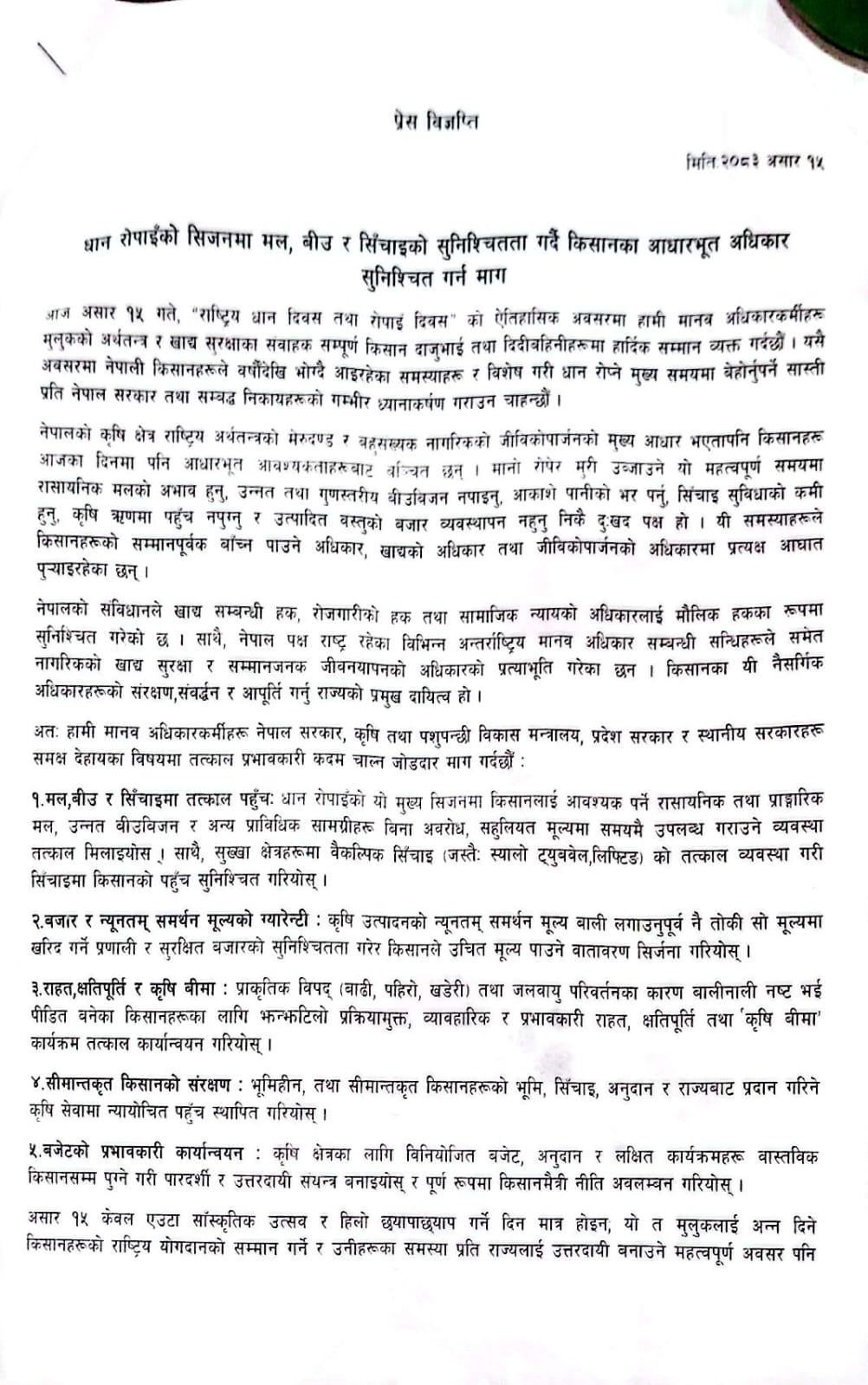

On the occasion of National Rice Day and Rice Planting Day, human rights defenders and various civil society organizations have issued a joint press statement drawing the attention of the Government of Nepal and relevant authorities to ensure the fundamental rights of farmers by putting forward a five-point demand.
The joint statement, issued on June 29, emphasizes that the state must take the long-standing problems faced by farmers, who form the backbone of Nepal’s economy and food security, more seriously. It highlights that, particularly during the main rice planting season, farmers continue to face severe difficulties due to shortages of chemical and organic fertilizers, the untimely availability of quality seeds, inadequate irrigation facilities, limited access to agricultural credit, and the lack of proper market management for agricultural produce.
The statement notes that although Nepal’s agricultural sector is the backbone of the national economy and the primary source of livelihood for the majority of the population, farmers continue to be deprived of basic agricultural services and facilities. It states that these challenges directly affect farmers’ rights to live with dignity, the right to food, and the right to livelihood. Stressing the effective implementation of the constitutional rights to food, employment, and social justice, the statement also reminds the government that, as a State Party to international human rights treaties, Nepal has an obligation to uphold the rights to food security and an adequate standard of living guaranteed under those instruments.
Human rights defenders and civil society representatives have called on the government to ensure the timely availability of chemical and organic fertilizers, improved seeds, and other agricultural inputs at subsidized prices during the peak rice planting season. They have also demanded that farmers’ access to irrigation be ensured by providing alternative irrigation systems, including shallow tube wells and lift irrigation, particularly in drought-affected areas. Furthermore, they have urged the government to determine the minimum support price for agricultural products before the planting season, procure produce at that price, and guarantee secure markets for farmers.
The statement further calls for the immediate implementation of effective relief, compensation, and agricultural insurance programs through hassle-free procedures for farmers whose crops have been damaged by floods, landslides, drought, and climate change. It also demands that landless and marginalized farmers be ensured equitable access to land, irrigation, agricultural subsidies, and state-provided agricultural services. In addition, it urges the government to establish transparent, accountable, and farmer-friendly mechanisms to ensure that the budget allocated to agriculture, subsidies, and targeted programs reach genuine farmers.
The statement emphasizes that June 29 should not merely be regarded as a cultural celebration or a day of playing in the mud, but as an important occasion to honor the contribution of farmers who produce the nation’s food and to hold the state accountable for addressing their problems. It stresses that the goals of food sovereignty, social justice, and sustainable development cannot be achieved without protecting farmers’ rights and ensuring their basic needs. Therefore, it calls on the state to move beyond declarations and take immediate, effective measures to address farmers’ concerns in practice.
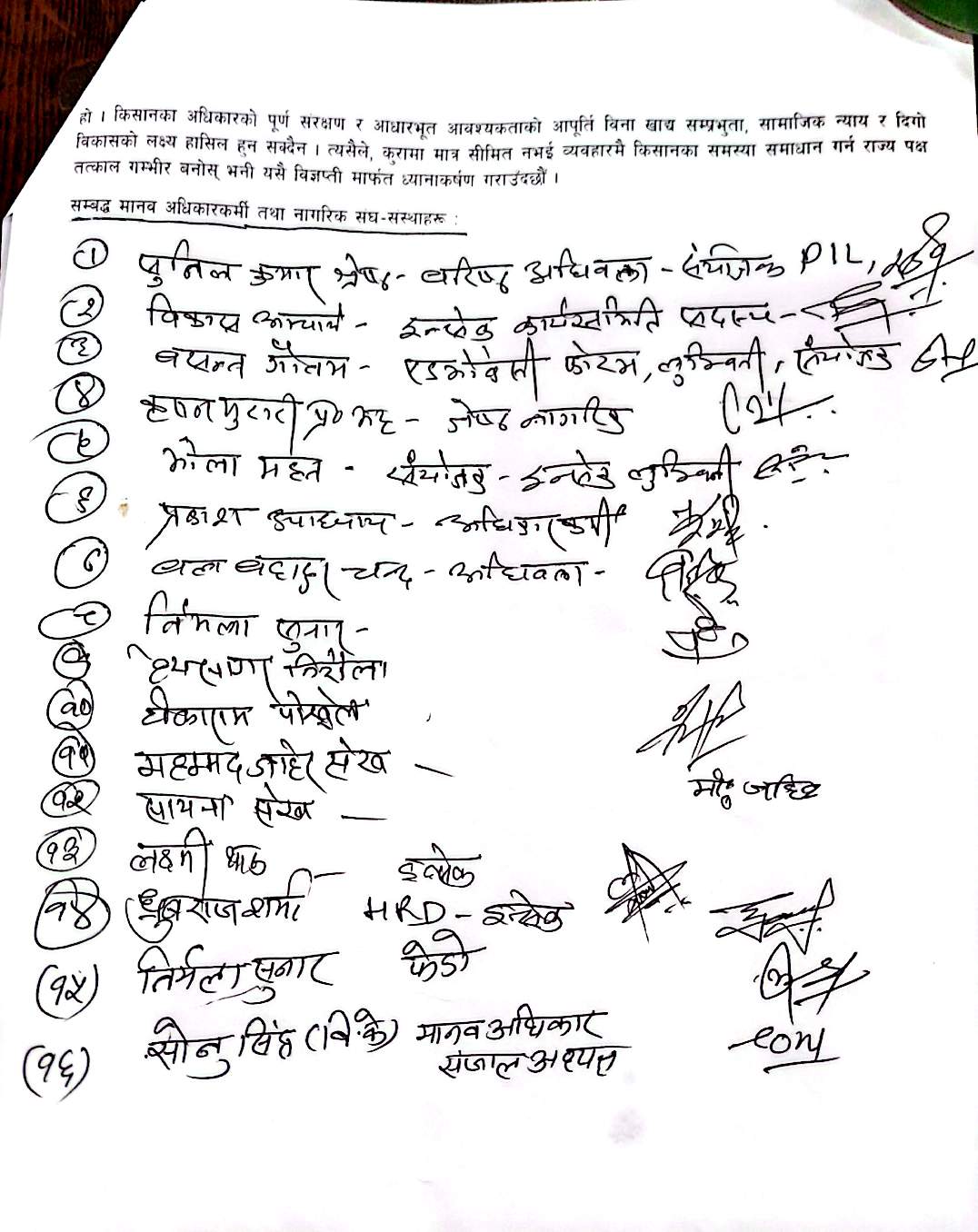
The statement is signed by Senior Advocate Sunil Kumar Shrestha, Coordinator of the Public Interest Lawyers Group, Nepalgunj; Advocate Bikash Acharya, Executive Committee Member of INSEC; Bhola Mahat, INSEC Lumbini Province Coordinator; Basant Gautam, Lumbini Province Coordinator of Advocacy Forum; senior citizen Krishnamurari Prasad Bhatt; Nirmala Sunar of FEDO; rights activist Prakash Upadhyaya; Advocate Bal Bahadur Chand; and other officials and representatives of human rights organizations.