

An interaction program of the Environmental Human Rights Defenders Network was held on June 23, 2026, organized by the Informal Sector Service Centre (INSEC) with support from DCA. Speaking at the program, INSEC General Secretary Geeta Baral stated that the melting of glaciers has already had negative impacts on people’s lives and emphasized that it could create even more severe challenges in the future.
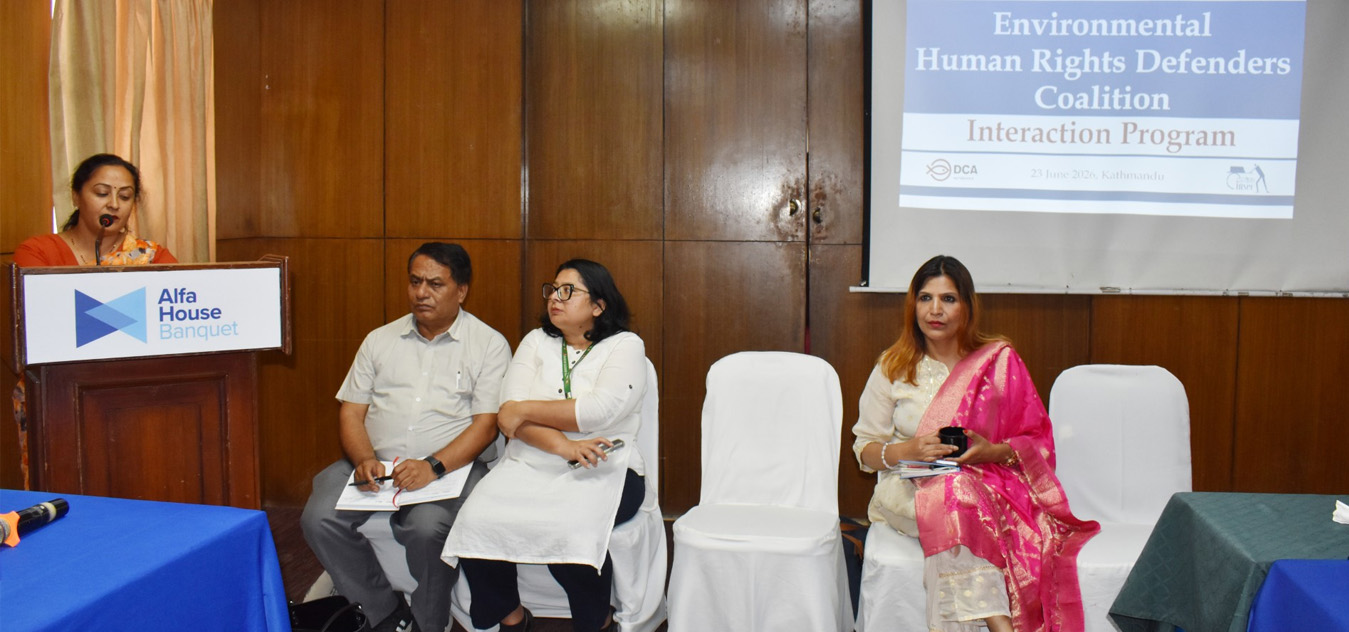
The Informal Sector Service Centre (INSEC), with support from DCA, organized an interaction program of the Environmental Human Rights Defenders (EHRD) Network on June 23, 2026.
Speaking at the program, INSEC General Secretary Geeta Baral recalled that INSEC has been documenting and archiving Nepal’s human rights situation, including incidents of human rights violations and abuses, since 1992, drawing national and international attention to these issues. She noted that although local, provincial, and federal governments have formulated policies related to environmental protection, implementation remains weak.
Baral expressed concern that climate change and environmental degradation are disproportionately affecting residents of mountainous regions and women, potentially creating a difficult humanitarian situation. She stated that these challenges have placed additional burdens on environmental human rights defenders and emphasized the need for collective action to mitigate the growing impacts of climate and environmental change.
At the program, Deepa Woli, Chief of the Planning, Monitoring, and Coordination Division at the Ministry of Agriculture, Forestry and Environment, and Deputy Secretary, presented a working paper on climate change and environmental human rights defenders. She noted that although policy provisions require 80 percent of climate-related budgets to be allocated to local governments, implementation remains inadequate. She also highlighted that insufficient attention to environmental impact assessments during development projects has contributed to environmental challenges in Nepal.
Woli further stated that women, children, and senior citizens are among the groups most affected by climate change and environmental degradation. Referring to Nepal’s context, she noted growing concerns among community forest activists regarding restrictions on community rights over forests. She also mentioned the increasing impact of monkeys migrating from forests and national parks into villages, describing it as a challenge that requires effective solutions.
She stressed that issues such as Chure conservation, the environmental impacts of the Godavari Marble Industry, and stone quarry operations should be addressed from an empathetic rather than merely sympathetic perspective regarding the rights of environmental human rights defenders.
Responding to participants’ questions, Woli said that government efforts to protect the Himalayas have increased and that resources generated through carbon-related initiatives have been channelled to affected communities through government mechanisms. She emphasized the need to transform perspectives on gender issues and stated that collaboration between the government and civil society is essential for addressing climate change and environmental conservation. She also underscored the importance of civil society holding the government accountable on policy matters and promoting cooperation to minimize climate and environmental impacts.
Manju Khatiwada, Deputy Secretary of the National Human Rights Commission, stated that environmental rights are an integral part of human rights and emphasized the government’s responsibility to implement the commission’s recommendations. She said the commission has repeatedly urged the government to take environmental and climate concerns seriously in the operation of industries, hospitals, and infrastructure projects, and has recommended both enforcing existing laws and enacting new legislation to address emerging issues.
Surya Kumari Sunar of DCA expressed concern that despite efforts spanning more than a decade, Nepal has yet to enact legislation specifically addressing the protection of environmental human rights defenders. She pledged continued collaboration on issues such as environmental rights violations and the impacts of industrial activities on communities. Sunar also expressed appreciation for INSEC’s role in maintaining the network and promoting collective action on climate and environmental issues.
During the discussion, Sanjay Panthi of Youth Action criticized government policies that promote tree plantation for carbon-related income while treating local residents as offenders when they collect forest products for their livelihoods.
Tashi Lama Hyolmo from Melamchi stated that the government has failed to play an accountable role regarding Indigenous Peoples’ rights and gender equality in the context of climate change and environmental issues.
Journalist Rima BC from Rupandehi questioned whether stakeholders are adequately involved in policymaking and argued that the absence of budget allocations consistent with government policies reflects neglect of citizens’ rights. She also criticized the lack of a clear vision regarding government efforts and collaboration with stakeholders on environmental rights.
Climate activist Diwakar Upreti drew attention to the government’s failure to allocate sufficient funding for Chure conservation and climate action and noted that even allocated budgets often remain unimplemented.
Educationist Dhirendra Kunwar emphasized the need to view climate change and environmental issues through a human rights lens and questioned why climate-related budgets are not reaching intended areas.
Rights activist Lakpa Lama noted that climate change and environmental impacts are increasing over time. Anu Joshi of the National Human Rights Institution from a national park-affected area argued that restrictions on harvesting old trees in Nepal, while allowing timber imports, have harmed consumers. She also suggested that restrictions on stone and gravel extraction in the name of environmental protection have created additional challenges.
Laxmi Mahato, sister of the late environmental activist Dilip Mahato from Dhanusha, questioned why violence against environmental activists continues. She demanded justice for victims, relief and compensation for affected families, and recognition of Dilip Mahato as a martyr. She alleged that the state has protected perpetrators rather than ensuring justice while extraction activities continue in the Chure region.
Rights activist Sushil BK stressed the importance of evidence-based work on environmental and climate issues and called for capacity-building initiatives and action plans that include meaningful youth participation.
Highlighting the need to include sanitation workers in environmental discussions, Ranjan Poudel of Panchkhal suggested that communities should be able to generate income from collecting forest products carried by floods. He also noted that the growing monkey population in Nepal’s mid-hill regions has led to a nationwide human-monkey conflict, contributing to declining agricultural production, rural outmigration, and increasing public debate. He questioned whether ecological imbalances may be contributing to this situation.
Rights activist Manju Mishra observed that wild animals, monkeys, and abandoned livestock are also affecting environmental conditions.
Jajaraj Giri, representing the Federation of Private Forests, called for rural communities to receive royalties and recognition for protecting environmental resources and water sources that benefit urban areas. He also highlighted that landless and squatter communities placed in holding centres by the government have been deprived of access to the natural resources they previously used.
Giri further stated that waste collectors face mistreatment rather than protection from the state and called for amendments to laws that can result in imprisonment for individuals who cut trees they themselves planted on private land for commercial purposes.
Participants collectively emphasized that climate change poses an increasing threat to human civilization, with direct negative impacts on education, health, food security, and peace, putting the future of humanity at risk.
Dilli Giri, General Secretary of FECOFUN, urged the state to recognize and support those working on climate change and environmental issues.
The program also highlighted findings from an ICIMOD report, which indicate that 250 million people living in mountain regions and 1.65 billion people living along river basins are among those most affected by climate change, demonstrating the close interrelationship between climate change and human rights.