

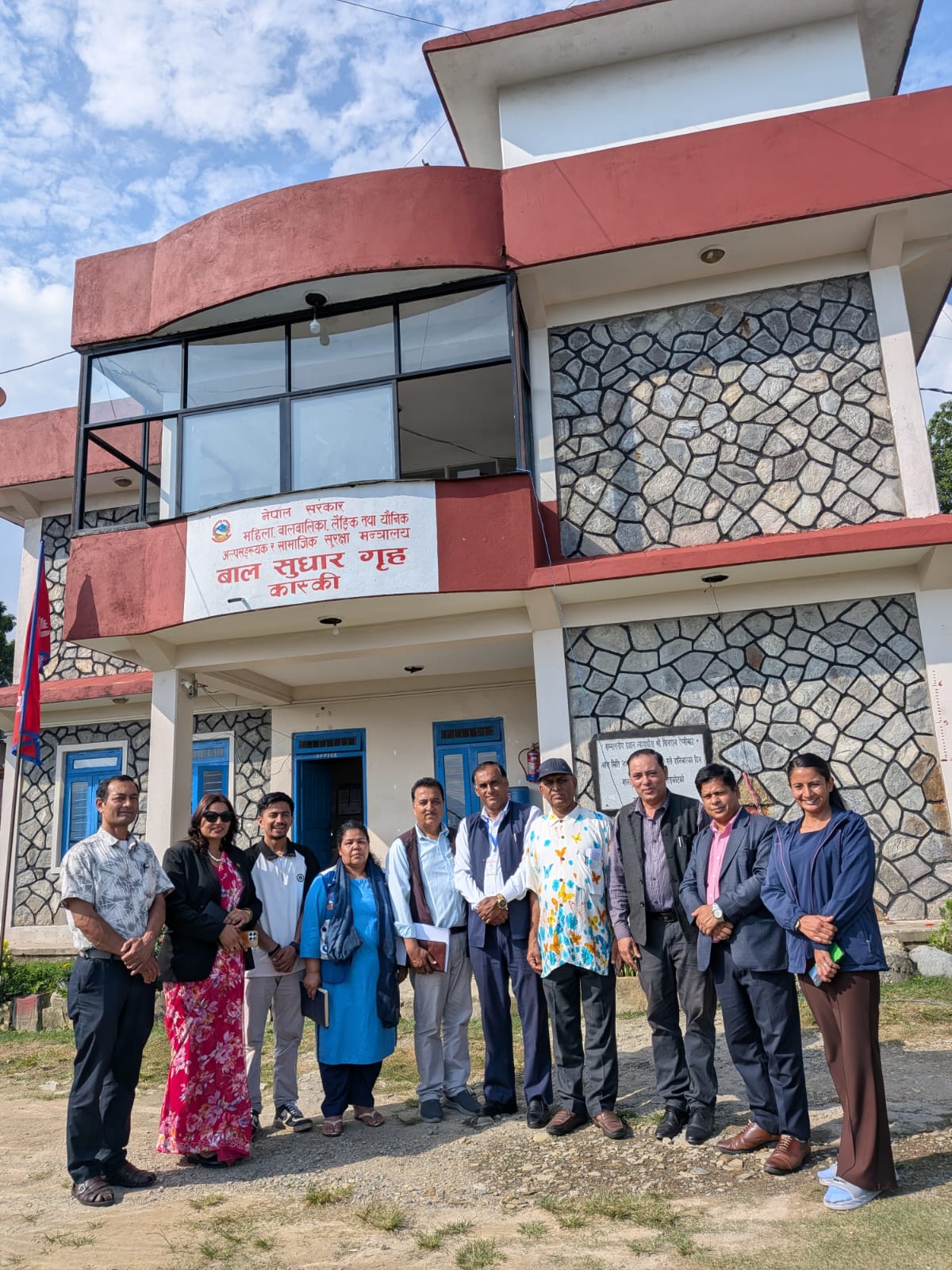
A monitoring visit was conducted on 25 June 2026 to assess the physical infrastructure, educational facilities, and internal management of the Child Reform Home in Pokhara, Kaski. The visit was initiated by Ganesh Bhandari, Gandaki Province Coordinator of Informal Sector Service Centre (INSEC), and included Nitu Gartaula, Chief of the Gandaki Province Office of the National Human Rights Commission, along with a team of human rights defenders and civil society representatives.
The monitoring team included Bishnu Prasad Baral, a leading human rights defender and civil society representative in Gandaki Province; Advocate Sarita Timilsina Pangeni; civil society representative Bijay Pangeni; and Engineer Milan Dumre, among others. The team also held discussions with Durga Raj Subedi, Head of the Kaski Child Reform Home, the principal of Vidya Jyoti Secondary School operating within the facility, and legal advisors regarding the overall condition of the correction home and measures for improvement.
According to official data provided by the reform home administration, there are currently 107 boys residing in the facility. Among them, 51 are above the age of 18 and 56 are below 18 years of age. Of the total population, 69 boys have already received court verdicts, while 38 are being held in pre-trial detention.
The monitoring found that the largest number of residents were detained in relation to rape cases, totaling 51 boys (33 convicted and 18 in pre-trial detention). Similarly, 20 boys were detained in murder cases, while three were held in vehicular homicide cases. Five boys were detained on drug-related charges, and six were held in incest-related rape cases.
INSEC Gandaki Province Coordinator Ganesh Bhandari shared experiences from other child reform homes across the country and pointed out that housing adults and minors together in the same facility increases the risks of internal security incidents and unrest. He noted that the absence of a clear legal provision requiring the automatic transfer of individuals who have reached the age of 18 and are legally adults to prison facilities has further complicated the situation.
He also committed to formally communicating with the Pokhara Metropolitan City to address the shortage of stationery supplies, notebooks, pens, and examination-related expenses within the correction home, and to seek both short-term and long-term budgetary support.
The legal advisor of the correction home stated that, in the past, some detainees with problematic behavior who had reached adulthood were transferred to prison through coordination and orders from the High Court. However, the lack of clear provisions in the law has created ambiguity and inconsistency in practice.
Civil society leader Bishnu Prasad Baral emphasized that the government must responsibly fulfill its obligations and that pressure should be exerted for necessary policy reforms.
Within the correction home, Navavidya Jyoti Secondary School, which has official approval to operate classes from Grades 6 to 10, is currently functioning. At present, 38 students are enrolled in Grades 6 to 10, while eight students are studying in Grade 11, 17 students in Grade 12, and five students are pursuing bachelor-level studies.
The school currently has only three approved secondary-level teaching positions for Mathematics, Science, and English. Other subjects and internal management responsibilities are being handled by correction home staff and educated inmates who voluntarily conduct classes. During discussions, participants raised the need to coordinate with Pokhara Metropolitan City or the Ministry of Education to increase teaching positions based on student numbers and subject-specific requirements.
The correction home building, which has a capacity of only 50 residents, currently accommodates more than twice that number (107 boys). Due to overcrowding, some boys are compelled to share a single bed, a situation that the correction home administration stated is negatively affecting both their health and behavioral rehabilitation.
To address the shortage of drinking water, correction home staff and security personnel have independently laid pipelines from a water source approximately six kilometers away and are currently relying on that supply. When disruptions occur, they must personally undertake repairs. This reflects inadequate attention from the government and relevant authorities to basic necessities such as drinking water and sanitation. Although one Auxiliary Nurse Midwife (ANM) has been assigned to provide healthcare services, the facility faces difficulties in responding to medical emergencies due to the lack of transportation and ambulance services. Furthermore, Durga Raj Subedi, Head of the Kaski Child Correction Home, stated that the daily food allowance of Rs. 80 per child is insufficient in the current economic context and does not allow for the provision of adequate, nutritious meals.
Nitu Gartaula, Chief of the National Human Rights Commission’s Gandaki Province Office, and representatives of civil society also expressed their commitment to raising concerns regarding the correction home’s sensitive situation, severe water crisis, and policy ambiguities with relevant ministries and authorities at the national level, and to undertaking concrete advocacy efforts to secure sustainable solutions.