

The Transitional Justice Monitoring Committee for Koshi Province was formed on November 5 in Biratnagar, the provincial capital, under the coordination of former Chief Attorney of the Koshi Province Government, Chudamani Acharya.
In accordance with the spirit of the Comprehensive Peace Accord, 2006, to document the truth, ensure compensation for the victims, create an environment of reconciliation in society, and hold the state accountable for human rights violations and serious crimes committed during the conflict, the “Koshi Province Transitional Justice Civil Monitoring Committee” has been formed under the coordination of former Chief Attorney Chudamani Acharya.
The Transitional Justice Civil Monitoring Committee, with INSEC’s founding chairperson Sushil Pyakurel as its coordinator and INSEC serving as its secretariat, has called for the recommendation of independent, impartial, competent, and expert individuals for the transitional justice commissions. Following this, the “Transitional Justice Civil Monitoring Committee” has been formed in Koshi Province under the leadership of former Chief Attorney Chudamani Acharya, representing 11 different organisations, to hold the state accountable for transitional justice issues in the province.
With the formation of the “Transitional Justice Civil Monitoring Committee” in Koshi Province, alongside the “Transitional Justice and the Way Forward” interaction program organised by INSEC in Biratnagar on November 5, the committee will work to create pressure on the federal government through the provincial government to hold the state accountable for transitional justice.
The “Transitional Justice Civil Monitoring Committee” has called for the recommendation of independent, impartial, competent, and expert individuals for the transitional justice commissions, following the implementation of important amendments to the “Investigation of Enforced Disappearances, Truth and Reconciliation Commission Act, 2071, which were passed by both houses of Parliament and ratified by the President on August 29, 2024. The committee issued this call on August 30, 2024, after the amendments came into effect.
The human rights activists participating in the interaction on “Transitional Justice and the Way Forward,” held in Biratnagar on November 5 under the chairmanship of INSEC Chairperson Dr. Kundan Aryal, expressed their belief that the formation of the “Transitional Justice Civil Monitoring Committee” will enable citizens to hold the state accountable and responsible.
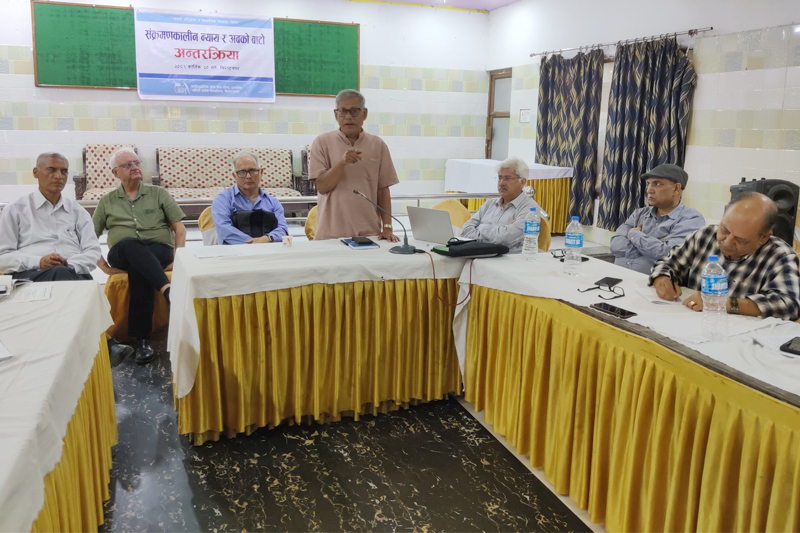
In the interaction program on “Transitional Justice and the Way Forward,” “Sushil Pyakurel” , the coordinator of the “Transitional Justice Civil Monitoring Committee” and founder chairperson of INSEC, stated that due to the lack of accountability in Nepal, even after nearly 20 years since the signing of the peace agreement, the victims have not experienced justice. He mentioned that, after a long period, the situation has now reached a point where transitional justice is finally moving towards a resolution. Pyakurel, the coordinator of the Transitional Justice Civil Monitoring Committee, emphasised that if the law is implemented, victims will be able to feel justice, and for that, civic vigilance is necessary at the grassroots level.
He mentioned that although commissions had been formed before, the same people who were involved in selecting officials for the old commissions are still part of the committee choosing officials now. For this reason, the “Transitional Justice Civil Monitoring Committee” called on 30 August 2024, for the recommendation of independent, impartial, qualified, and expert individuals for the transitional justice commissions. He also made it clear that people who carried weapons during the armed conflict, whether from the state side or the rebel side, should not be included in the new committees. Committee coordinator Pyakurel also explained that since monitoring is needed from the start of the commission appointment process, a “civil monitoring committee” has been set up as well.
In the interaction program on “Transitional Justice and the Way Forward,” INSEC’s Executive Director “Bijayraj Gautam” mentioned that since INSEC also serves as the secretariat for the “Transitional Justice Civil Monitoring Committee” , its role in the transitional justice process will be even more significant. Executive Director Gautam explained that INSEC has conducted detailed studies and maintained records on various aspects, including damage reports from the conflict, details of the injured and forcibly disappeared individuals, reports on serious human rights violations and abuses during the conflict, on-the-ground monitoring reports, and the list of martyrs published by the government in the official gazette. He emphasized that INSEC holds valuable truth and factual information, which will help ensure justice for those affected by the transitional justice process.Executive Director Gautam stated that since INSEC also serves as the secretariat for the “Transitional Justice Civil Monitoring Committee”, it will play an important role in creating pressure on the state to ensure the selection of appropriate individuals for the transitional justice process and the transitional justice commissions.
In the interaction program on “Transitional Justice and the Way Forward,” civil leader and human rights activist “Kankamani Dixit” explained that the transitional justice process took longer to move forward because of obstacles caused by the Maoists. He said, “The Maoists slowed down the process out of fear that it would harm their political interests. But now, with the important amendments to the “Enforced Disappearances, Truth and Reconciliation, and Reconciliation Commission Act, 2071” approved by the President on August 29, the role of civil society and organizations will be very important.” He also mentioned that INSEC and other social organizations have raised the voices of the victims and those affected by the conflict, and now that the state is restarting the transitional justice process, there is a need for the “Transitional Justice Civil Monitoring Committee” to help ensure victims receive justice. The committee has been formed under the leadership of qualified, impartial, and independent individuals.
In the interaction program on “Transitional Justice and the Way Forward,” former Attorney General of the Koshi government Chudamani Acharya expressed the view that all parties must cooperate to ensure the newly formed commission provides justice to the victims. He also stated that the formation of the “Transitional Justice Civil Monitoring Committee,” with INSEC serving as its secretariat, was made at the right and appropriate time for transitional justice.
In the program, political scientist Krishna Pokharel analysed that the transitional justice process is now reaching a conclusion because no political power remains in Nepal to gain any further advantage. He also expressed his belief that, with the “Transitional Justice Civil Monitoring Committee” monitoring the appointment of experts to the commission, the process will expand to all provinces.
In the interaction program, Dinesh Shrestha, the former president of the Nepal Intellectuals’ Council of Morang and a rights activist, expressed the opinion that the transitional justice process should be concluded by following a middle path, in line with the sentiments of the victims. He stated that although there are some differences between the wars in the world and the conflict in Nepal, it is the responsibility of the state to ensure justice for the victims.
In the program, senior journalist Yagya Sharma stated that the delay in the transitional justice process is due to both the state and the rebel sides having come to power through a joint movement. He emphasized that the commission should be headed by an impartial person, not based on political power-sharing. Sharma pointed out that if the committee is formed on the basis of political power-sharing, it will end up like previous commissions, which failed to deliver results.
In the interaction program, the secretary of the Nepal Press Union, Morang branch, Netra P. Adhikari, stated that although the transitional justice bill has been passed, the victims of the conflict themselves are doubtful about whether it will provide them with justice. In the program, rights activist Khilanath Niroula emphasized the need for civil monitoring to understand the victims’ emotions and create an environment where they can feel justice. He also mentioned that it is necessary to establish civil monitoring committees in the provinces as well.
In the interaction program, the acting president of the non-governmental organization in Morang, Sarita Khanal, suggested that the commission should appoint individuals who have the courage to work independently, free from political pressure and influence. In the program, Saroj Bhusal from UNFPA emphasized the need to establish impact-friendly monitoring committees at the local level. Additionally, Diliram Lamsal, a human rights officer at the National Human Rights Commission, stated that the state must take immediate steps to bring an end to the transitional justice process.
In the program, advocate Rukmina Dahal mentioned that the Advocacy Forum has raised objections to several provisions and definitions in the law. She emphasised the importance of appointing experts in the subject and law as officers of the commission.
Central member of the Nepal Bar, Sita Poudel, highlighted the necessity of forming civil monitoring committees in every province to ensure accountability.
During the interaction, conflict victim Januka Pokhrel demanded that the whereabouts of her two sons, who went missing during the conflict, be made public. Conflict victim Tulsi Prasad Apagai expressed that he no longer believes the state in this country can deliver justice.
INSEC Koshi Province coordinator Somraj Thapa stated that despite the change in the political system, the situation of conflict victims has not improved. He emphasized that now it is necessary for all representatives of civil society, along with conflict-affected families, to unite and work towards resolving the issue of transitional justice.
In the interaction program, it was discussed that the “Transitional Justice Civil Monitoring Committee” will continuously monitor every activity carried out by the The Commission of Investigation on Enforced Disappeared Persons (CIEDP) and the Truth and Reconciliation Commission (TRC), provide suggestions to the commissions, and offer constructive support to ensure justice for the victims.