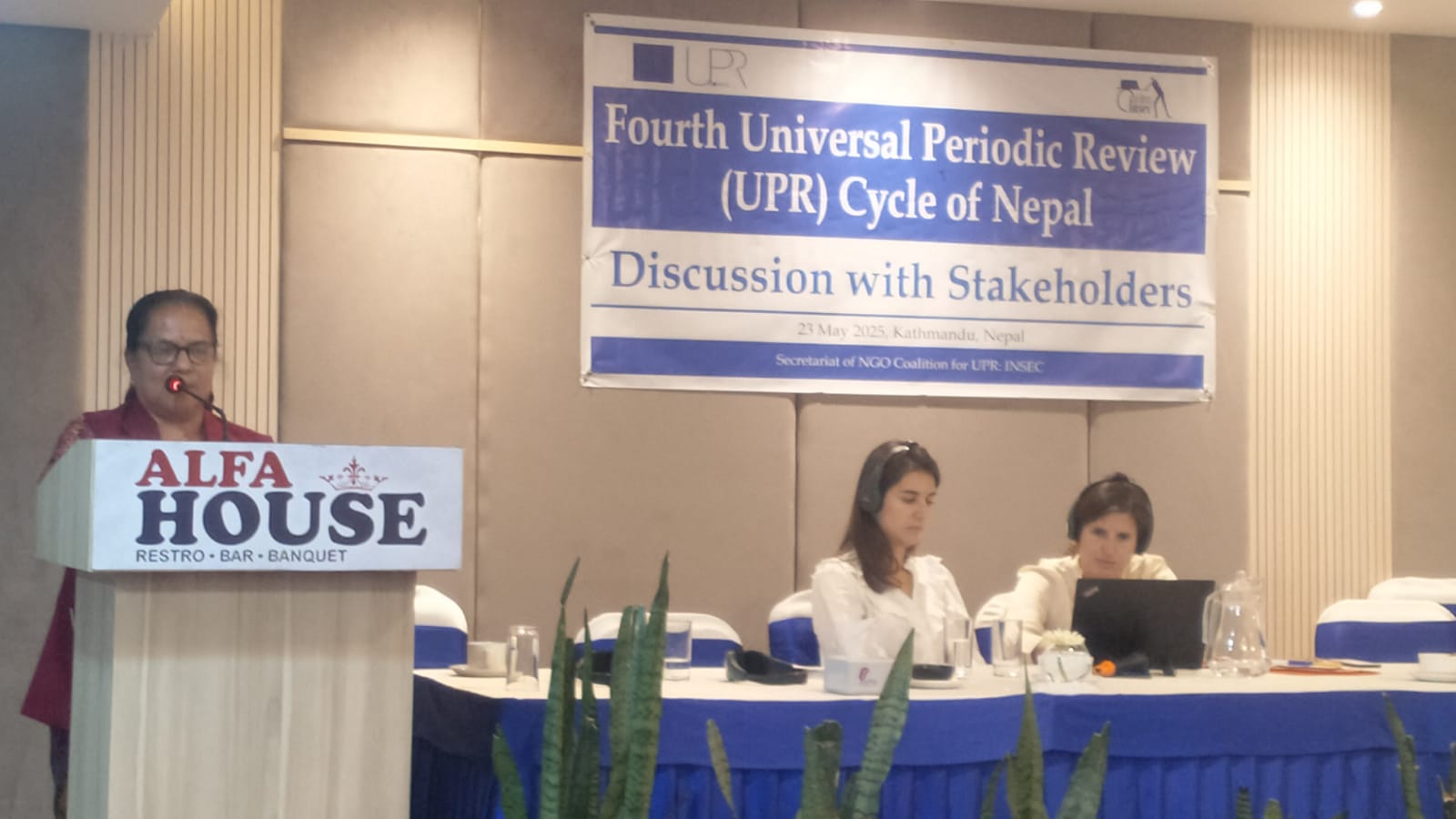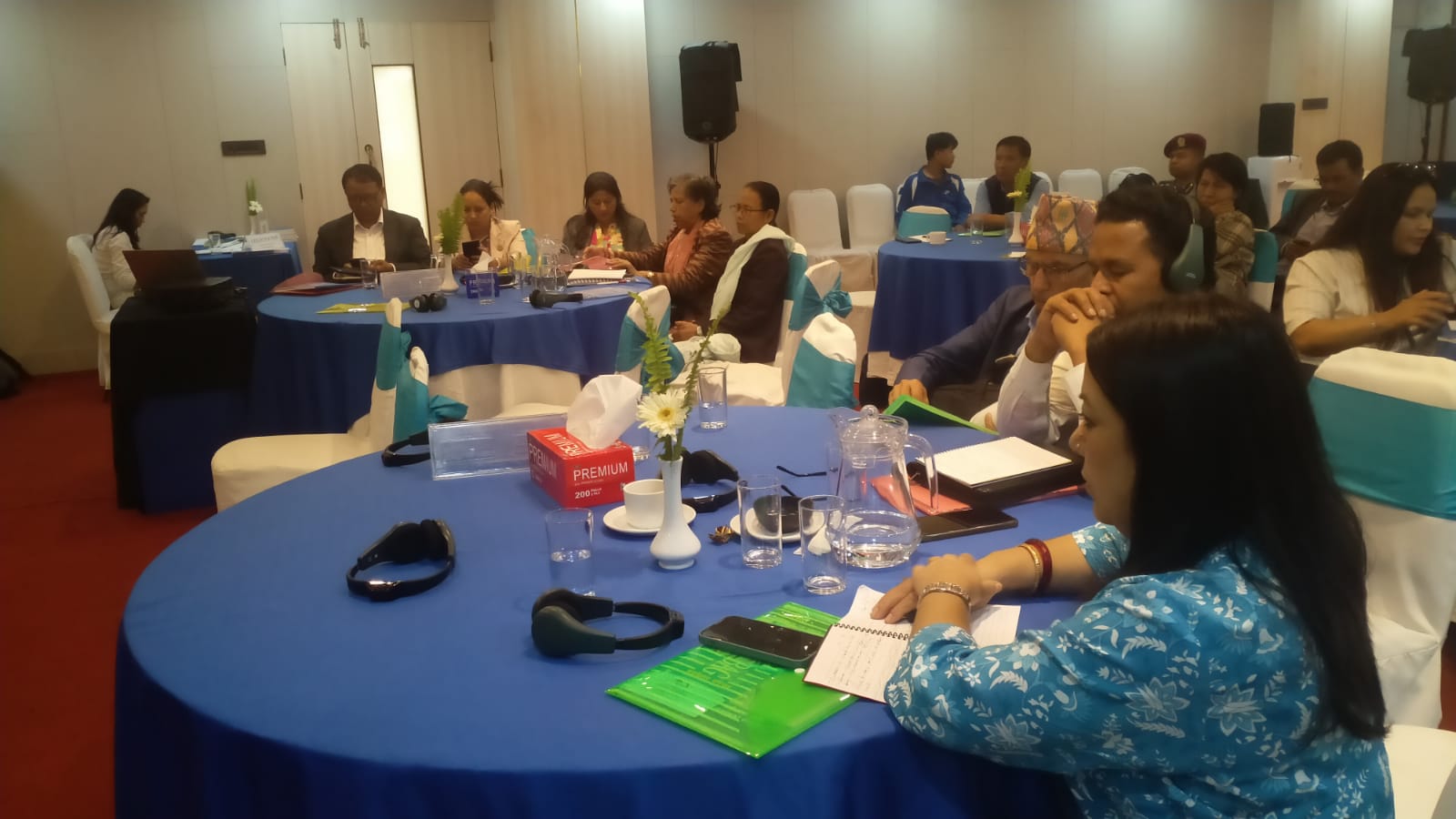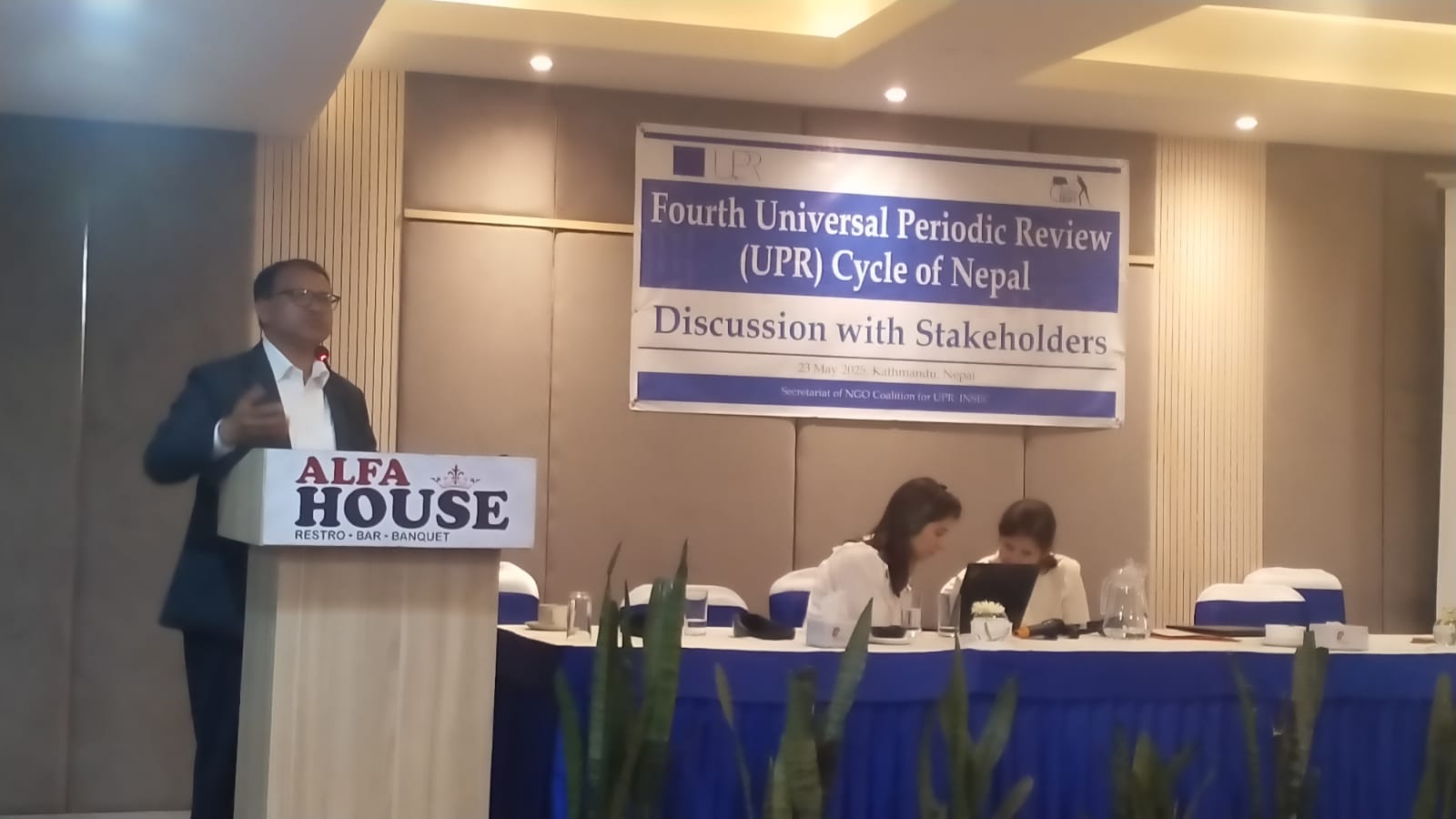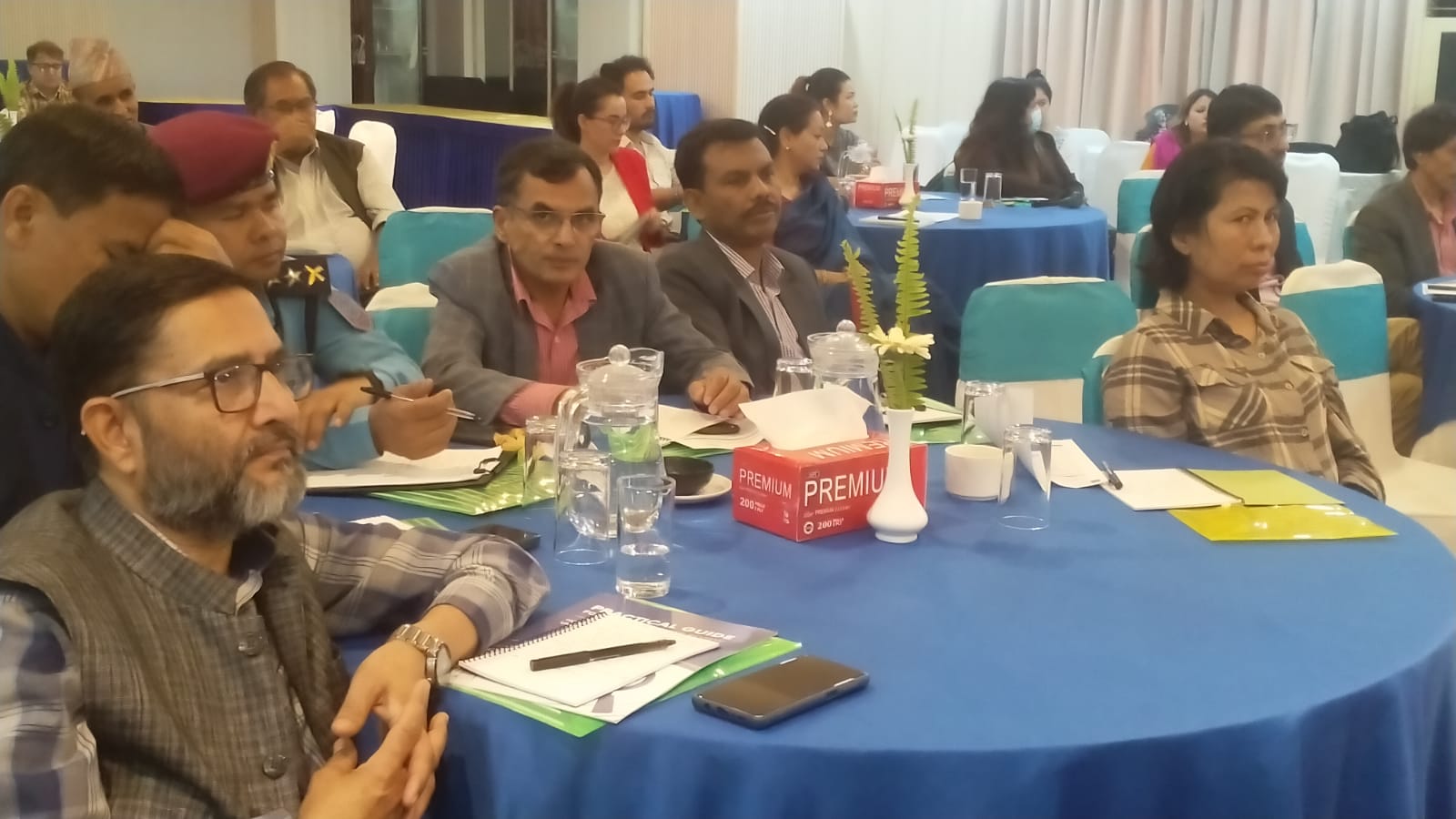

A discussion has been held among stakeholders for the fourth cycle of the Universal Periodic Review (UPR) of human rights. The program, organized by the Informal Sector Service Centre (INSEC) and UPR Info, was attended by members of parliament, members and joint secretaries of the National Human Rights Commission, representatives of the National Women Commission, Human Rights Alliance, Nepal Police, and representatives from non-governmental organizations.
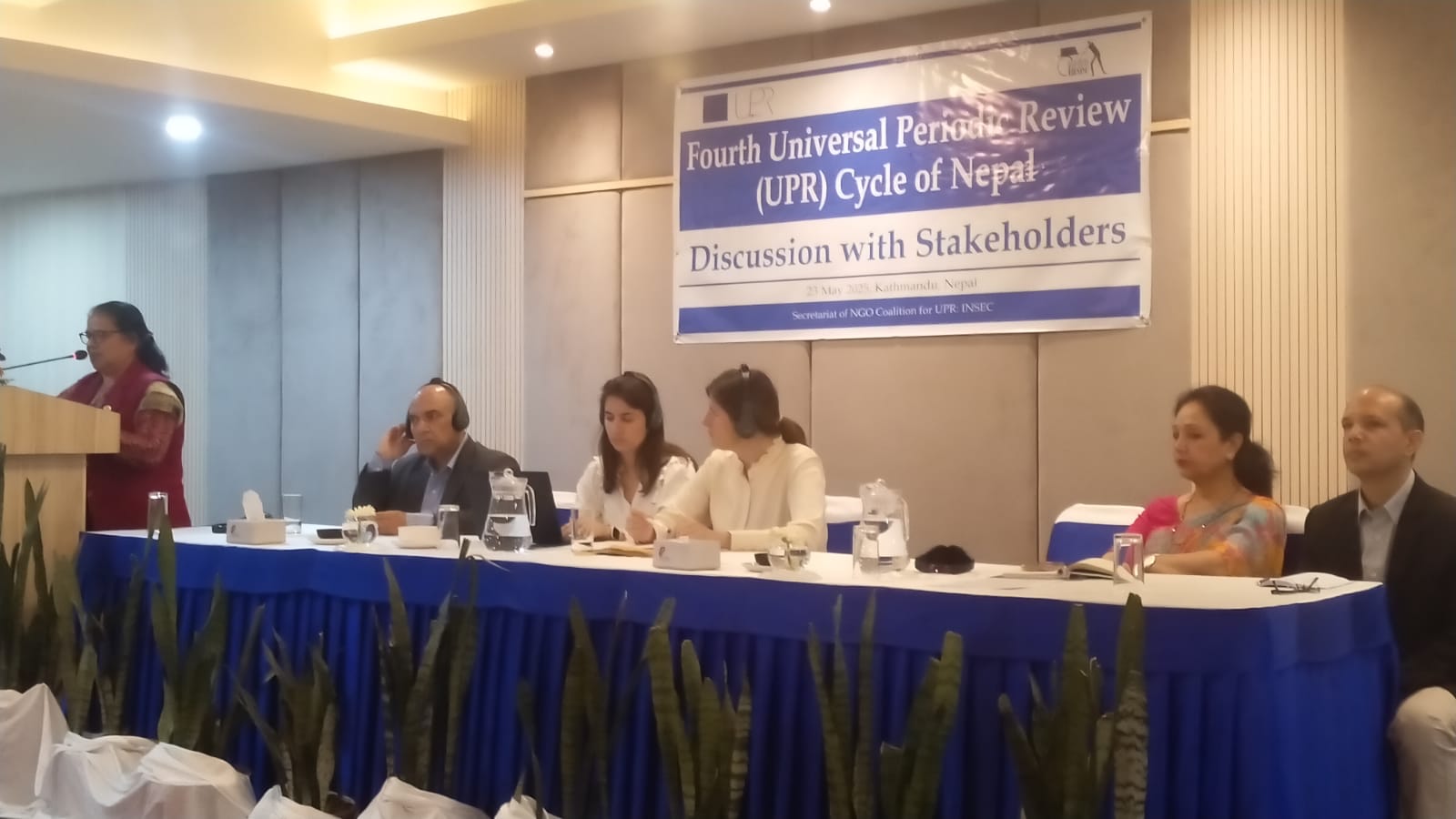
Tulsa Kumari Dahal, Chairperson of the Legislative Management Committee of the National Assembly, emphasized the need for the committee to reassess the laws that must be made in accordance with the Constitution as well as the implementation status of existing laws. She highlighted the necessity of giving directions based on Nepal’s available resources and capacities, stressing that members of parliament should be clear whether their focus is on law making or on development and organizational work in their electoral constituencies.
Jiwan Pariyar, a member of the Law, Justice, and Human Rights Committee of the House of Representatives, emphasized the need for discussions involving the committee chairperson regarding the Universal Periodic Review (UPR) of human rights. He drew attention to the weak implementation of laws enacted according to the Constitution of Nepal. He stressed that since the execution of state-made laws has been weak, civil society must hold the government accountable and persistently demand answers. He also urged that the government should be made aware of the failure to implement fundamental rights.
Member of Parliament Chandra Bahadur Bishwakarma discussed how it is possible for the United Nations to view the state of human rights with the same perspective globally, given that the economic, social, and cultural conditions of citizens in developing and developed countries differ, which also affects the state of human rights. He emphasized that, rather than focusing on development, significant resources are spent on the production of weapons of destruction, and highlighted the need to address this issue from a human rights perspective.
Member of Parliament Dipa Sharma stated that it is necessary to improve not only the submission of reports to international forums but also the timely selection of representatives to attend those forums, as delays have led to formalistic presence with weak presentations. She emphasized that, given the three levels of government, it is essential to raise awareness, foster consciousness, encourage study, and provide training on human rights issues to all representatives—from parliamentarians to local government officials.
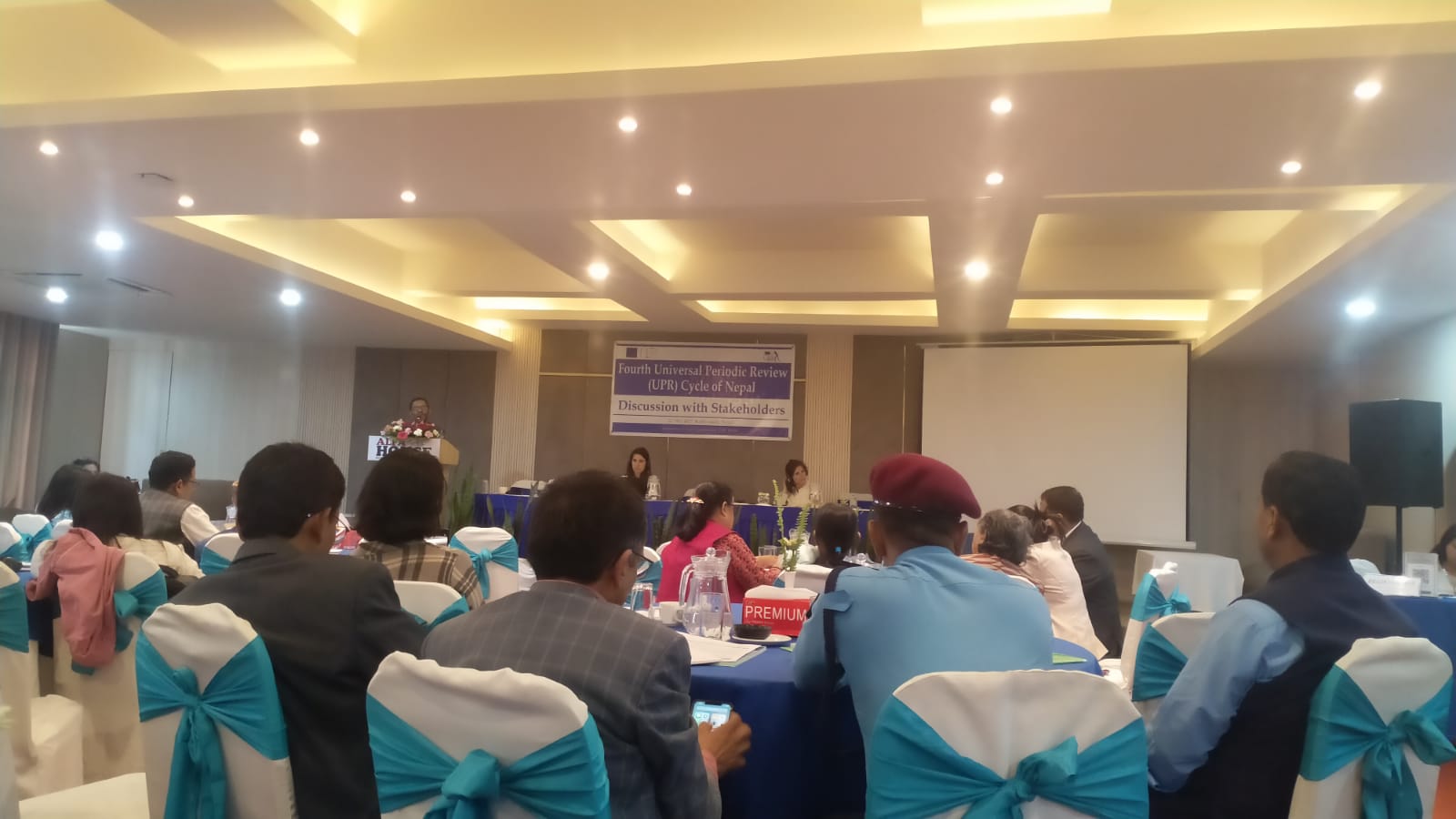
Member of Parliament Gopal Bhattarai emphasized that Nepal has suffered damages from the effects of climate change caused by others and stressed that the United Nations should take initiative to ensure compensation and justice for Nepal.
Member of Parliament Menuka Kumari Pokharel expressed a commitment to focus on legal and practical solutions to transform the country’s environment and situation accordingly. She discussed the ongoing efforts to restore indigenous crops in Nepal by replacing them with hybrid varieties, emphasizing that indigenous crops are very important from a health perspective.
Lili Thapa, a member of the National Human Rights Commission, pointed out that some reports and recommendations submitted to the United Nations have been repetitive. She drew attention to the fact that although the Nepal government has amended certain laws, their implementation remains lacking. She recalled that periodic reports are submitted through the integrated efforts of 440 organizations in Nepal and highlighted that this process provides an opportunity to share best practices regarding improvements in the human rights situation. She added that this enables the government, the National Human Rights Commission, and civil society organizations to not only submit reports but also conduct monitoring on a global scale.
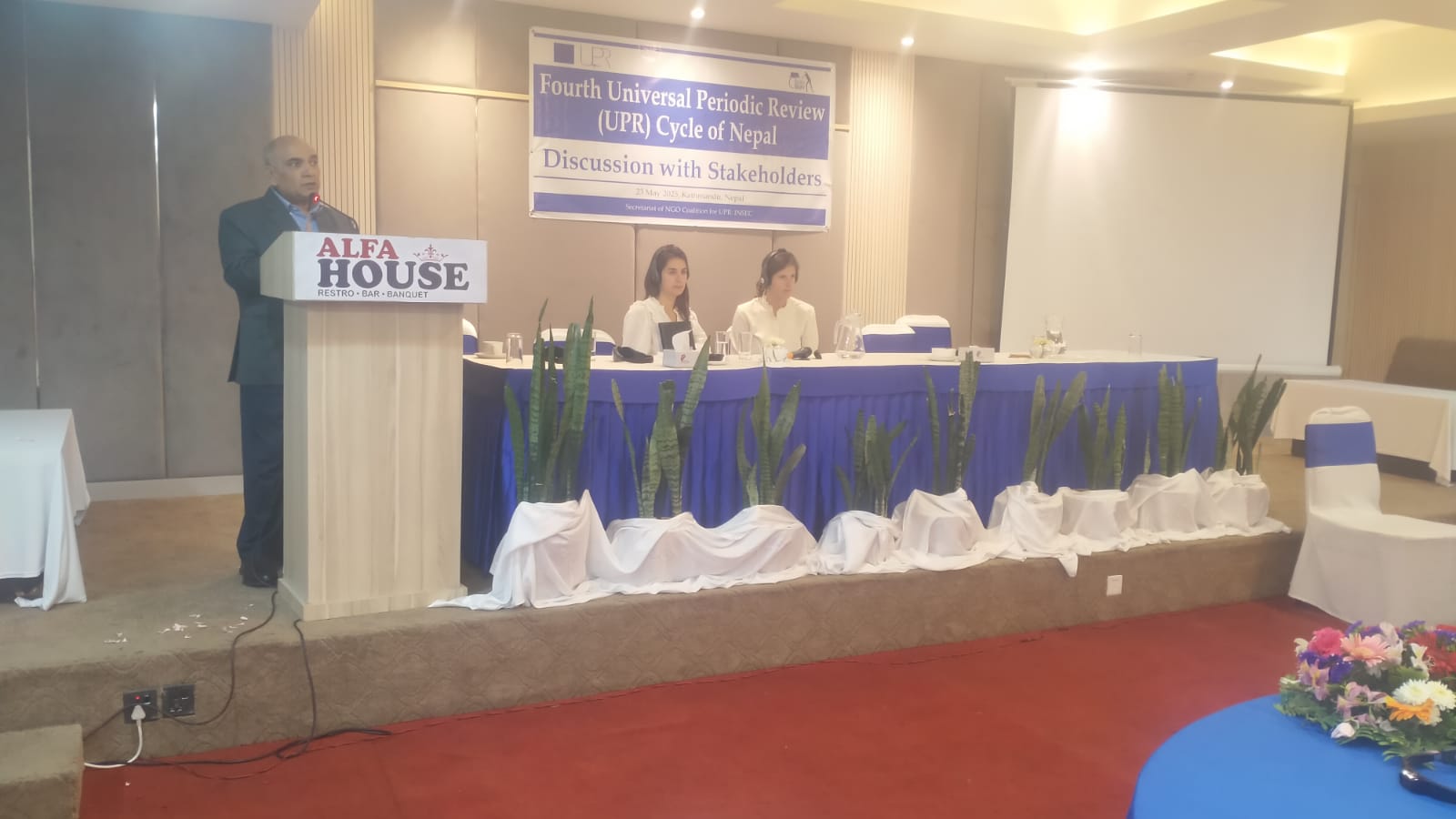
At the program, Bijayraj Gautam, Executive Director of INSEC, highlighted the purpose of the workshop and explained the process of the Universal Periodic Review (UPR). He stated that the suggestions and feedback provided by civil society organizations play an important role in shaping the recommendations of the UPR process.
During the discussion, Claire Moratto, Program Coordinator of UPR Info, appreciated the collaborative efforts of Nepal’s civil society in preparing reports submitted to the Universal Periodic Review (UPR).
Camille Miguet, representative of UPR Info, recalled that the United Nations provides equal opportunities to all countries. He explained that the UPR is an opportunity to enhance the situation and capacity in the field of human rights, to engage participants in the UPR process, and to facilitate the strengthening of human rights mechanisms.Miguet suggested that with Nepal scheduled to submit its report to the United Nations in October 2025, the government must finalize the commitments it will make and the issues it will note. He stated that the government will present the national report, the National Human Rights Commission’s report, and civil society organizations’ reports to the United Nations. He also noted that they provide updates on the implementation status of previously given recommendations.
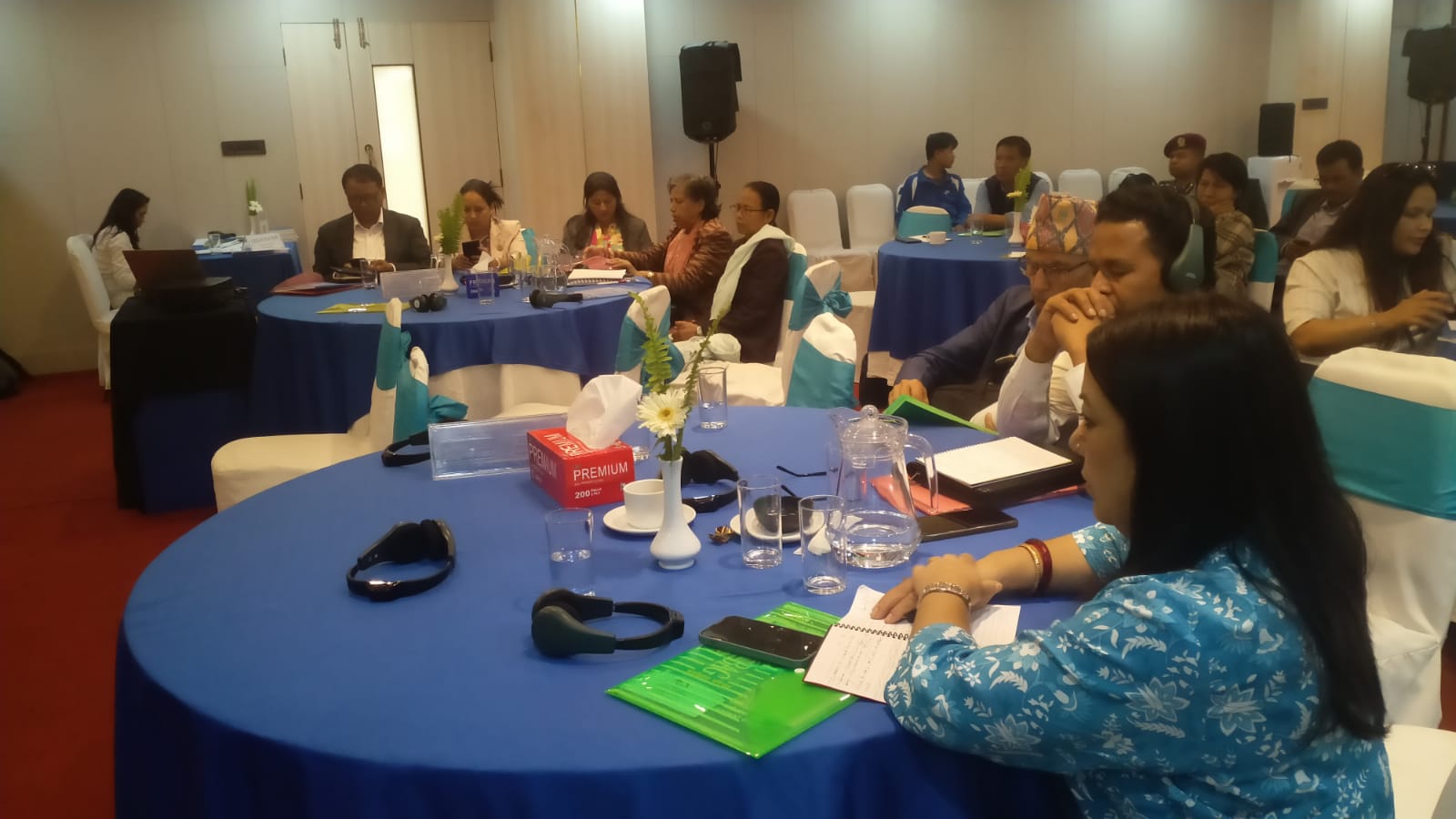
During the discussion, Kapil Aryal, advisor of UPR Info, explained that they compile the suggestions from the discussions on UPR to prepare the final report. He mentioned that the final refined report is created by incorporating the feedback received from the program. He mentioned that the Universal Periodic Review program reviews reports from 193 countries worldwide. He explained that, according to United Nations policy, a dialogue takes place every four years where the government and civil society discuss the reports through a dual consultation process. Aryal shared information about Nepal Government’s participation in various phases of representation since 2011, starting under the leadership of then Foreign Minister Sujata Koirala.
Human rights activist Bhakta Bishwakarma discussed that as a member state of the United Nations Human Rights Council, Nepal plays an important role in conducting periodic reviews of the global human rights situation in an equal manner. Bishwakarma emphasized that since the government, the National Human Rights Commission, and civil society submit tripartite reports for discussion, members of Nepal’s parliamentary human rights committee must actively engage in discussions on issues such as discrimination and transitional justice cases and ensure the submission of reports.
Renu Sijapati, representative of the Feminist Dalit Organization (FEDO), urged to prioritize the rights of Dalit women. She called for attention to discrimination based on caste, gender, and class, as well as good governance, within the integrated UPR mechanism.
Yagyaprasad Adhikari, Deputy Secretary of the National Human Rights Commission, emphasized that the Constitution of Nepal has established a three-tier government system, which is being implemented. He stressed the need to develop a practice of forming human rights committees at the local level and focusing on local government actions from a human rights perspective.
Bidur Subedi, Chairperson of the Human Rights Alliance, reminded that local governments have the role to implement fundamental rights and human rights guaranteed by the Constitution. He emphasized the need to raise awareness and consciousness to build the right understanding from the perspectives of development, good governance, and human rights. He urged the development of a practice to view the work done by local governments from a human rights perspective. He also emphasized the need to establish an institutional stance on the ongoing work through the Commission concerning the rights of informal sector workers and transitional justice.
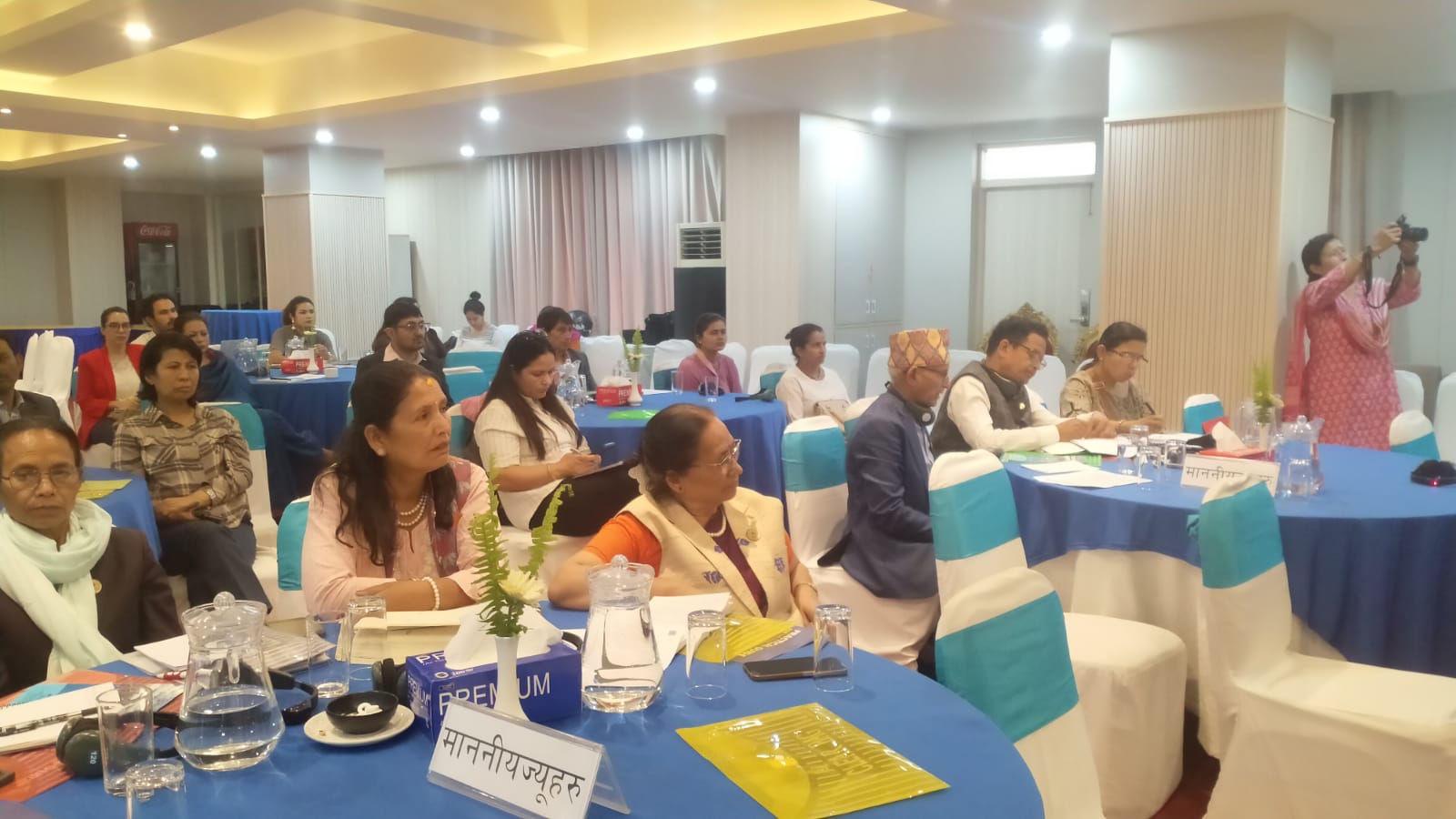
Maya Sharma, representative of the National Human Rights Commission’s Treaty Monitoring Division, stated that although the Commission is a national human rights body, it faces significant challenges in its functioning. She emphasized the need to establish a unified understanding about the Commission across all three levels of government. She also urged Nepal’s side to provide clear positions in response to the repeated recommendations given on the submitted reports. She emphasized that, since Nepal has a three-tier government system, the good practices happening at each level should also be highlighted as examples.
Bhawani Kharel, a representative of the Human Rights Institution, stated that the human rights situation in Nepal is deteriorating and highlighted the conflictual nature of transitional justice issues. She emphasized the need to discuss the reports submitted by the state to the United Nations and present them collectively with a unified stance.
Samjha Shrestha, Chief of Human Rights Advocacy Program at INSEC Central Office, emphasized that the fourth cycle of the Universal Periodic Review (UPR) is important for guaranteeing citizens’ human rights and urged participants to provide suggestions for the report.