

At the interaction program on Business and Human Rights jointly organized by Informal Sector Service Centre (INSEC), Madhesh Province, and Janakpurdham Chamber of Commerce and Industry in Janakpur on May 25, Madhesh Province Minister for Industry, Commerce and Tourism, Kanish Patel, stated that the provincial government is committed to the development of business and entrepreneurship. He stated that businesspersons should be able to conduct trade freely, while taking action against traders who sell substandard goods or exploit consumers is the responsibility of the Chamber of Commerce and the concerned authorities. He also expressed the provincial government’s commitment to undertake necessary initiatives, collaboration, and policy reforms to create a business-friendly environment and ensure the protection of human rights.
He emphasized that both officially registered and unregistered informal businesses should take the issue seriously, as the conflict between them has negatively affected the business environment. He further pointed out that providing quality services is a business responsibility. Minister Patel also stated that a policy would be introduced to encourage and reward traders who contribute to the business sector and pay higher taxes.
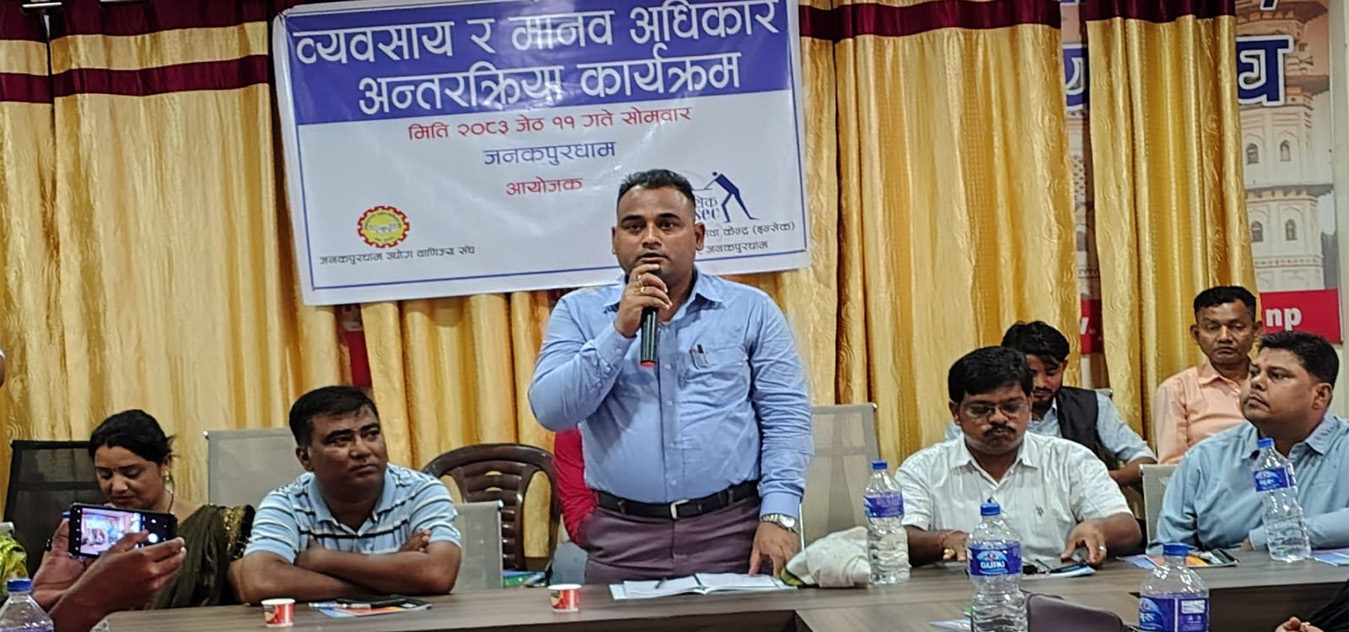 Chief of the National Human Rights Commission, Madhesh Province Office, Buddha Narayan Sahani, presented on the concept of Business and Human Rights, stating that the role of the state, the responsibilities of business enterprises, and the rights of citizens are interlinked issues. He expressed the view that ensuring that no one’s human rights are violated during the operation of businesses is a shared responsibility of both the state and the private sector.
He stated that equal protection of consumers, dignified treatment of workers, and the provision of remedies fall under the fundamental principles of international human rights. He further mentioned that, beginning from the 1948 Universal Declaration of Human Rights, organizations such as the Organisation for Economic Co-operation and Development (OECD), the International Labour Organization (ILO), and the United Nations Human Rights Council (UNHRC) have advanced standards related to business and human rights. He informed that more than 35 countries around the world have already implemented National Action Plans and stressed that effective implementation of such a plan is also necessary in Nepal.
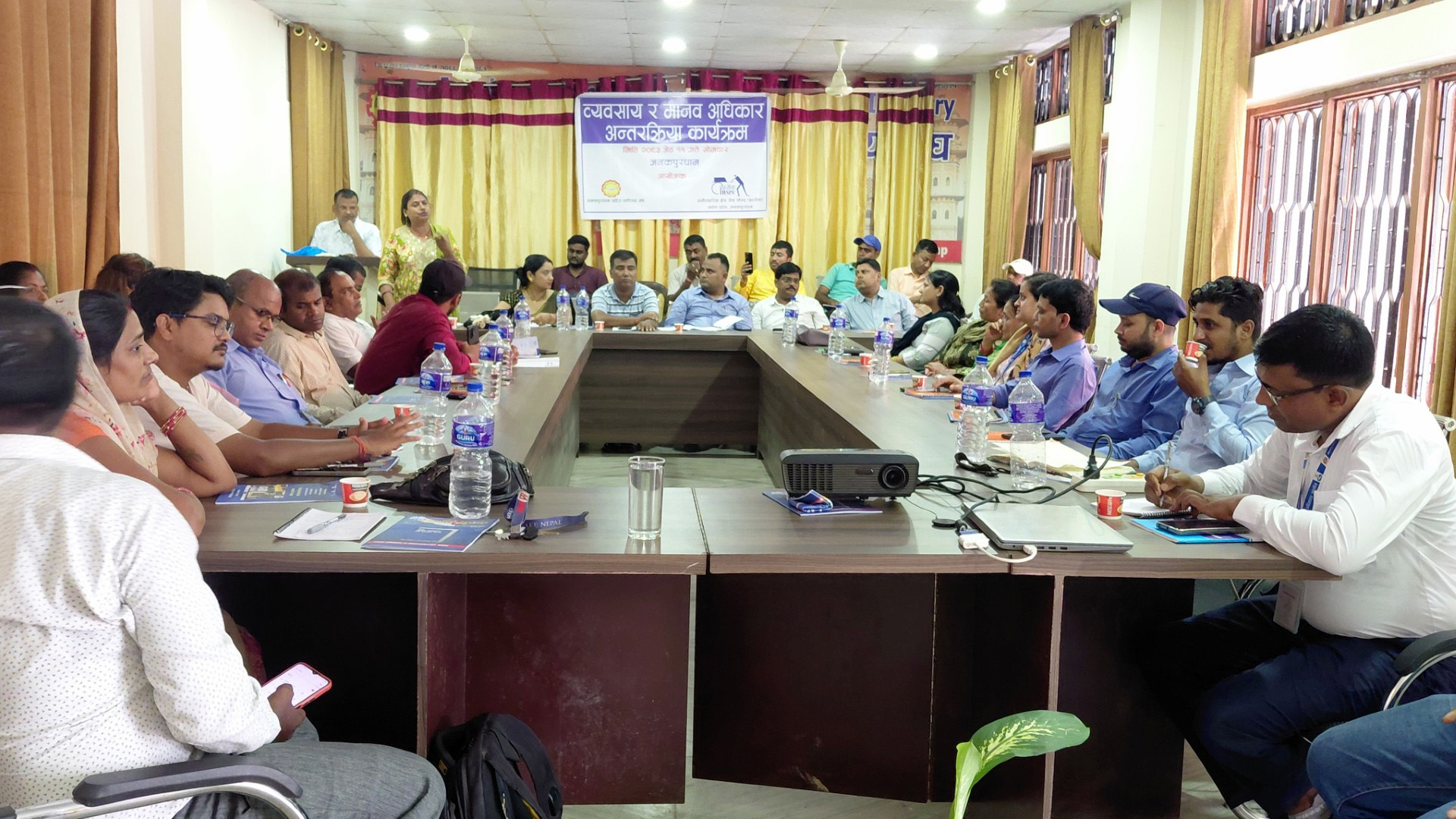
Similarly, Coordinator of INSEC Madhesh Province Office, Raju Paswan, stated that the relationship between business and human rights has become a highly sensitive and important issue in the present context, emphasizing that businesses should not be viewed solely as profit-oriented activities but also in connection with social responsibility. He stated that while operating businesses, it is necessary to ensure workers’ rights, consumer protection, equal treatment, safe working environments, and social justice. According to him, a sustainable and trustworthy business environment can only be built if businesspersons are able to create a human rights-friendly environment. He further stated that business enterprises must move forward while respecting state laws, labor standards, and consumer rights.
President of Janakpurdham Chamber of Commerce and Industry, Surendra Bhandari, expressed gratitude to INSEC for organizing, for the first time during his one-and-a-half-year tenure, an interaction program focusing on the rights of businesspersons and human rights issues. He complained about unlawful raids conducted by the police and incidents of physical assault against him, stating that actions carried out without respecting legal procedures and human rights are wrong. He remarked that it is inappropriate to treat people engaged in business as criminals and emphasized that businesspersons should also be treated with dignity and respect. He further stated that state authorities should prioritize human rights and due process while enforcing laws.
Women Vice-President of Janakpurdham Chamber of Commerce and Industry, Rinku Shah, stated that equal treatment, respect, and opportunities should be ensured between women and men businesspersons. She said that women still face discrimination, uncomfortable behavior, and a lack of encouragement when entering the business sector, and emphasized that the state, Chamber of Commerce and Industry, and social organizations should take special initiatives to attract women towards trade and entrepreneurship. According to her, regular training, facilitation, and protection are necessary to strengthen the rights, security, and confidence of women entrepreneurs. She also stressed that human rights defenders and concerned authorities should conduct market monitoring from time to time and pay attention to issues of discrimination and rights violations occurring in the business sector.
Vice-President of the Dhanusha branch of the Federation of Nepali Journalists, Awadhesh Kamat, thanked INSEC for organizing an interaction program linking business with human rights and stated that the issue needs to be raised more broadly. He pointed out that incidents such as repression, violence, threats, and abduction against businesspersons are also matters of human rights violations and urged that such incidents be included in future Human Rights Yearbooks. Mentioning that small businesspersons are still facing problems due to a lack of management and identification, he expressed the view that the Chamber of Commerce and Industry should take initiatives to ensure mandatory shop numbering for all small businesses. According to him, a healthy business environment cannot be created unless the security, dignity, and rights of businesspersons are ensured.
Human rights defender Kamlesh Mandal stated that businesspersons also have the right to work in a dignified and secure environment. He expressed the view that businesspersons should not only be seen as taxpayers or traders, but as responsible actors contributing to the country’s economic development. According to him, unnecessary administrative pressure, insecurity, and discriminatory behavior during business operations weaken the business sector, and therefore, the state should pay special attention to creating a business-friendly environment. He also emphasized the need for cooperation among all stakeholders by understanding business and human rights as complementary to one another.
Likewise, human rights defender Binod Mahara stated that many businesspersons in Janakpurdham are being forced to relocate due to insecurity, unorganized markets, and the weakening business environment. He stated that quality service, responsibility towards consumers, and business ethics are extremely essential to sustain businesses.
Officials of the Janakpurdham Chamber of Commerce and Industry, businesspersons, human rights defenders, and media personnel, among others, were present at the program.