

The decision of the government to table a bill regarding transitional justice, without any discussion has left stakeholders concerned.
Stakeholders expressed their dissatisfaction at a discussion program on “Transitional Justice: Challenges and Future Actions” organized by INSEC in Kathmandu on 10 March 2023.
Victims of the armed conflict and human rights activists have expressed dissatisfaction regarding the bill tabled in the parliament to amend the Commission for Investigation, Truth and Reconciliation Act of the disappeared persons and demanded a comprehensive discussion regarding the amendment.
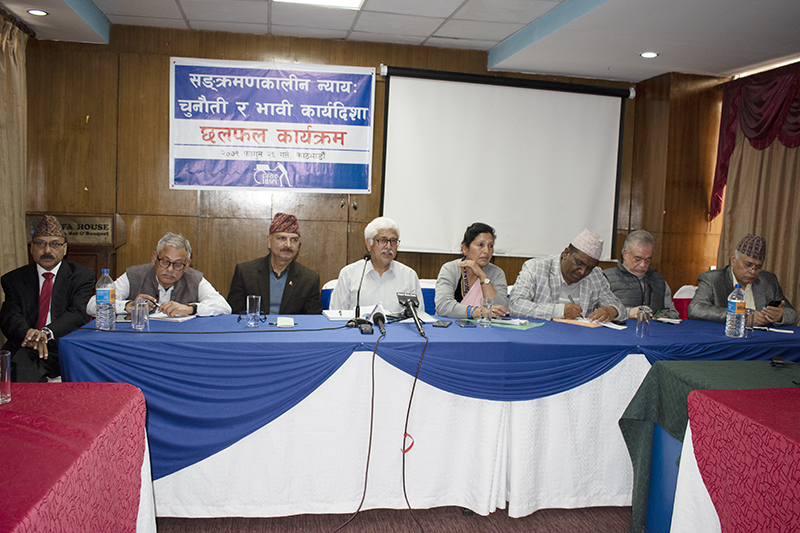
They have requested the government to amend the bill to address the demands of the conflict victims and complete the peace process as soon as possible.
Former member of the National Human Rights Commission and founding chairperson of INSEC, Sushil Pyakurel said that there should be a comprehensive discussion about the provisions in the proposed bill.
“The victims of the conflict should stand together for justice,”
Charan Prasai, a human rights activist, drew the attention of the government and stakeholders to the fact that political will is important to complete the work of the peace process.”
Justice should be given to the victim and punishment should be given to the perpetrator.” – Chairperson of the Informal Sector Service Center (INSEC), Kundan Aryal , said – “Individuals and families who suffered from violations of human rights and humanitarian laws in the 10-year conflict should have access to justice .”
He said that it is sad that the victim has to plead for justice and emphasized that justice should be given to the victim immediately. The former chairperson of INSEC, Subodhraj Pyakurel, said – “The actors involved in the conflict have neither properly apologized to all the victims of the conflict, nor implemented the necessary rehabilitation plan for the victims.”
He emphasized that the commissioners of the Commission for Transitional Justice must maintain its credibility and trustworthiness.
Former chairperson Pyakurel said – ‘The commission should be empowered to implement in the matter of reconstruction, rehabilitation, and immediate relief.’
Suman Adhikari, the former chairperson of the Conflict Victim group, expressed his displeasure with the bill and said – ‘It seems that the state does not want to provide justice to the conflict victim. There is no political will to give justice to the victims.’
Sushila Chaudhary, a conflict victim, said that if the bill is passed without addressing the demands of the conflict victims, it will not be acceptable.
In the previous bill, the provision of ‘no appeal to the special court hearing for the case related to conflict’ has been changed. The right of the victim to go to the Supreme Court has been addressed in the bill that has been tabled now.
It is stated in the proposed bill – ‘The party who is not satisfied with the judgment or final order of the special court can appeal to the Supreme Court within 35 days from the date of such judgment or final order.’
In the proposed bill, killing, sexual violence, physical or mental torture, kidnapping and hostage-taking, illegal detention, beating, maiming or maiming, looting, seizing, vandalizing or arson of private or public property, forcible eviction from a house or any other inhuman act of displacement or in violation of international human rights or humanitarian law are defined as violations of human rights.
Serious violations of human rights are defined as ‘brutal torture or brutal killing, forced labor, enforced disappearance of persons and inhuman or cruel torture’.
On 15 July 2022, the then Law and Justice Minister, Govinda Prasad Koirala, tabled the amendment bill. The term of Parliament ended while the bill was under consideration.