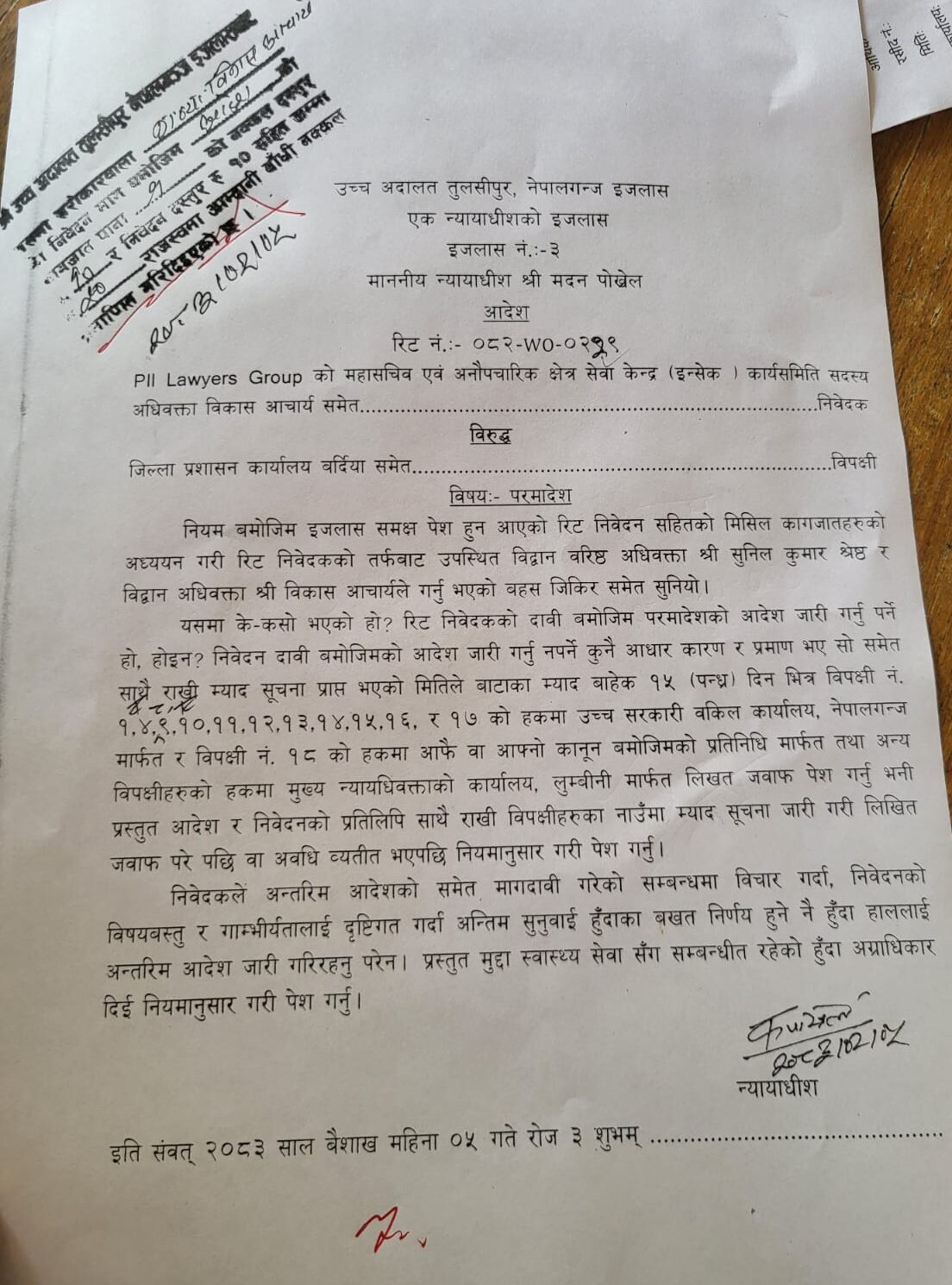

The High Court in Tulsipur, Nepalgunj Bench, has issued a show-cause order in a writ petition filed demanding the effective implementation of the Ambulance Service Directive, 2025, and legal provisions related to vehicles and transportation.
A single bench of Justice Madan Pokharel conducted a preliminary hearing on the writ petition registered on May 18 and issued a show-cause order in the name of the respondents. The court stated that it reached this decision after studying the case documents attached to the writ petition and hearing arguments from the petitioners’ side, including Senior Advocate Sunil Kumar Shrestha and other petitioning advocates.
The petitioners in the writ include Advocate Bikash Acharya, Secretary of the Public Interest Law Lawyers’ Group and Executive Committee Member of the Informal Sector Service Centre (INSEC); Advocate Basant Gautam, Senior Provincial Coordinator of Advocacy Forum Nepal; Advocate Bal Bahadur Chand; Advocate Suresh Kumar Gautam; human rights activist and INSEC Lumbini Province Coordinator Bholanath Mahat Kshetri; Krishna Murari Bhatta; and Uday Bahadur Singh Shrestha, among others.
The respondents named in the writ include the Ministry of Physical Infrastructure and Transport, the Ministry of Health and Population, relevant ministries under the Lumbini Provincial Government, transport management offices, district administration offices, Nepal Police, Traffic Police, health offices, and district ambulance management committees.
The petitioners have argued that although ambulance service is an essential service directly linked to the life and health of citizens, most ambulances are being operated contrary to the minimum standards prescribed by law. The writ states that operating ambulances without oxygen, life-saving equipment, trained health workers, GPS systems, and necessary technical facilities is putting patients’ lives at risk.
Similarly, the writ claims that the collection of arbitrary fees through substandard ambulances, their use for purposes other than transporting patients, and allowing vehicles with Indian number plates to operate without the necessary temporary route permits have resulted in violations of the rule of law, consumer rights, and citizens’ right to health.
The writ petition has requested the court to issue an interim order to stop the operation of ambulances that do not meet the standards of the Ambulance Service Directive, 2025, including operating permits, GPS installation, affiliation with dispatch centers, service classification, equipment, and trained personnel. It has also requested the court to prohibit Indian-numbered ambulances and other vehicles from operating within Nepal without the necessary temporary route permits as required by the Vehicle and Transport Management Act, 1993.
The writ states that the right to live with dignity under Article 16, the right to health under Article 35, the right to equality under Article 18, and the right to information under Article 27 of the Constitution of Nepal have been violated, and has requested the issuance of a mandamus order directing the respondent authorities to implement the Ambulance Service Directive and related legal provisions strictly.
In its order, the court has directed the respondents to submit written replies within 15 days from the date of receipt of the notice, excluding travel time, explaining any basis, reason, or evidence why a mandamus as sought in the petition should not be issued. As per the order, some respondents must submit written replies through the Office of the High Government Attorney, Nepalgunj, while other respondents must submit through the Office of the Chief Attorney, Lumbini Province.
The court has not, however, issued an immediate order on the interim relief sought by the petitioners. The order states that, considering the subject matter and seriousness of the petition, the decision on the interim order will be made during the final hearing, and for now, it is not necessary to issue an interim order. The court has also ordered that, since this case relates to health services, it be given priority and scheduled for a hearing according to the rules.