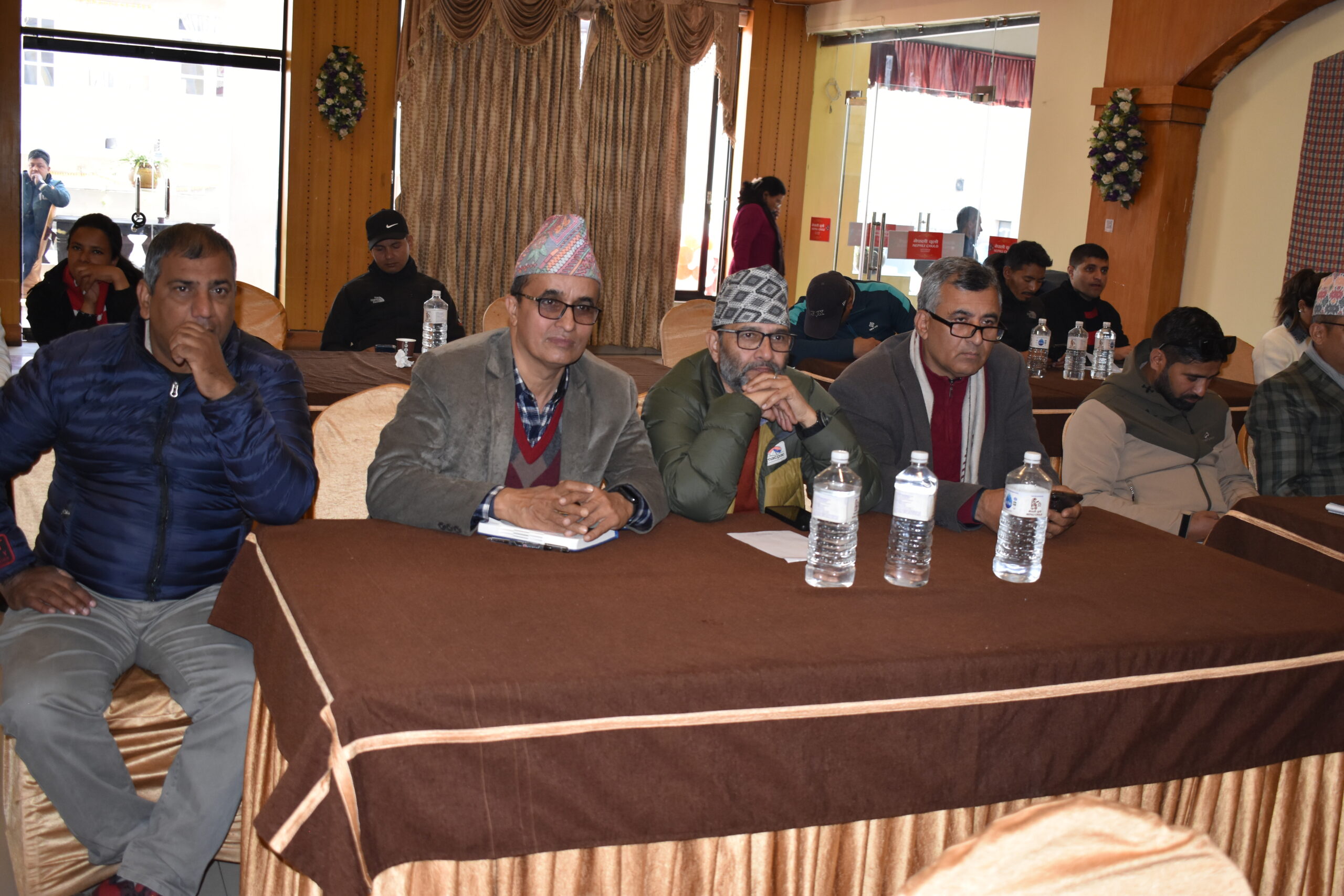

Home Minister Om Prakash Aryal has stated that elections are essential for the stability of democracy. He made this remark while speaking at an interaction program titled “Elections and Participation for the Stability of Democracy,” jointly organized by the Informal Sector Service Center (INSEC) and the Human Rights Organization of Nepal (HURON).
Participants of the interaction program, held in Kathmandu on January 8, 2026, emphasized that periodic elections are indispensable for strengthening the democratic system.
Home Minister Om Prakash Aryal noted that a fear-free environment is necessary for free and fair elections. Referring to the Gen Z movement of September 8 and 9, he stated that efforts were made to steer the country away from retaliation and violence and to create an election-oriented environment. He further added that, to promote good political governance, a conducive environment for youth participation in politics has been created by adding new voters to the voter registration list.
 “I will always stand on the side of human rights and victims. I am not in favor of impunity, and impunity will not be encouraged in a way that would place the country on a blacklist,” said Home Minister Aryal.
He expressed the government’s commitment to making all necessary arrangements for election security. He stated that an environment has been created for the Gen Z generation to be able to vote and to come into the mainstream of the state.
Minister Aryal mentioned that, as a person who has fought for rights, he is not in favor of impunity, and added that since the Gen Z movement entrusted him with responsibility, he would return to his legal profession after the elections are completed.
At the program, INSEC Chairperson Vijay Raj Gautam recalled that INSEC and HURON have networks across the country and stated that they would play a neutral role by monitoring the period before, during, and after the elections to assess whether the elections are free and fear-free.
 President of the Federation of Nepali Journalists, Nirmala Sharma, stated that during the Gen Z movement, journalists and media houses suffered losses amounting to Rs. 180 million, and noted that an environment conducive to free and fair elections has not yet been created.
She recalled that even after the government announced the elections, a suitable environment for conducting elections was found to be lacking, and informed that in 2025, 218 journalists were unable to write news freely.
 Human rights defender Charan Prasai questioned what the election environment in the country is like and whether the government has created a conducive environment. He recalled that political parties have stated that they have not received a favorable environment for elections and that the Gen Z generation has been found to be dissatisfied with the election environment. He further stated that the situation is not like the period following the changes of 2062/2063, when parties such as the Nepali Congress and CPN-UML were able to confidently prepare for elections in a fear-free environment.


She emphasized that, in addition to election observers, journalists should also monitor whether polling stations provide a friendly environment for persons with disabilities, senior citizens, postpartum and pregnant women, and provide suggestions and recommendations on these matters to the Government of Nepal, the Election Commission, and other relevant bodies.
Human rights defender Bhawani Kharel highlighted the need to create an environment where voters can cast their ballots fearlessly, reflecting on elections held under the Panchayat system, the multi-party system, and the federal democratic republican system across different periods. She also stated that it is the civic duty of citizens to inform government agencies if they receive information about weapons seized during the conflict period up to the Gen Z movement.

Gen Z human rights activist Luja Maharjan pointed out that social media prioritizes trivial matters merely to increase views, and expressed the view that the country’s relative development has been hindered due to government instability.

Gen Z representative Upama Pokharel emphasized that women’s participation in elections must be equal in order to safeguard democracy. Gen Z representative Prashant Paudel stated that the foremost condition of democracy is that elections must be conducted through public participation, and emphasized that everyone’s active involvement is necessary to ensure successful elections. He drew the state’s attention to the lack of disability-friendly polling centers in the hilly regions, which hinders the participation of those communities.
Participants of the program noted that, along with the damages caused during the Gen Z movement, the coalition government has yet to create a suitable environment for elections.