

Stakeholders have stated that elections strengthen democracy. In a discussion held on March 2 in Ghorahi with journalists, election observers, civil society members, and human rights activists, stakeholders emphasized that free and fair elections are essential to reinforce democracy. Speaking at a discussion on elections, security, and voter rights organized by the Federation of Nepali Journalists (FNJ) in Dang, former executive committee member of the Informal Sector Service Center (INSEC), Shobhakar Budhathoki, stated that if voters are unable to cast their votes in a free and fear-free environment, the resulting outcomes cannot safeguard democracy.
“Political parties must be able to reach the people without obstruction. Likewise, voters should be able to vote fearlessly for the party and candidate of their choice,” security expert Budhathoki said. “For this, an environment ensuring security and voter education must be created. Above all, security and a smooth election process are essential.” He also stressed that the indispensability of elections must be viewed in connection with democracy and the constitution.
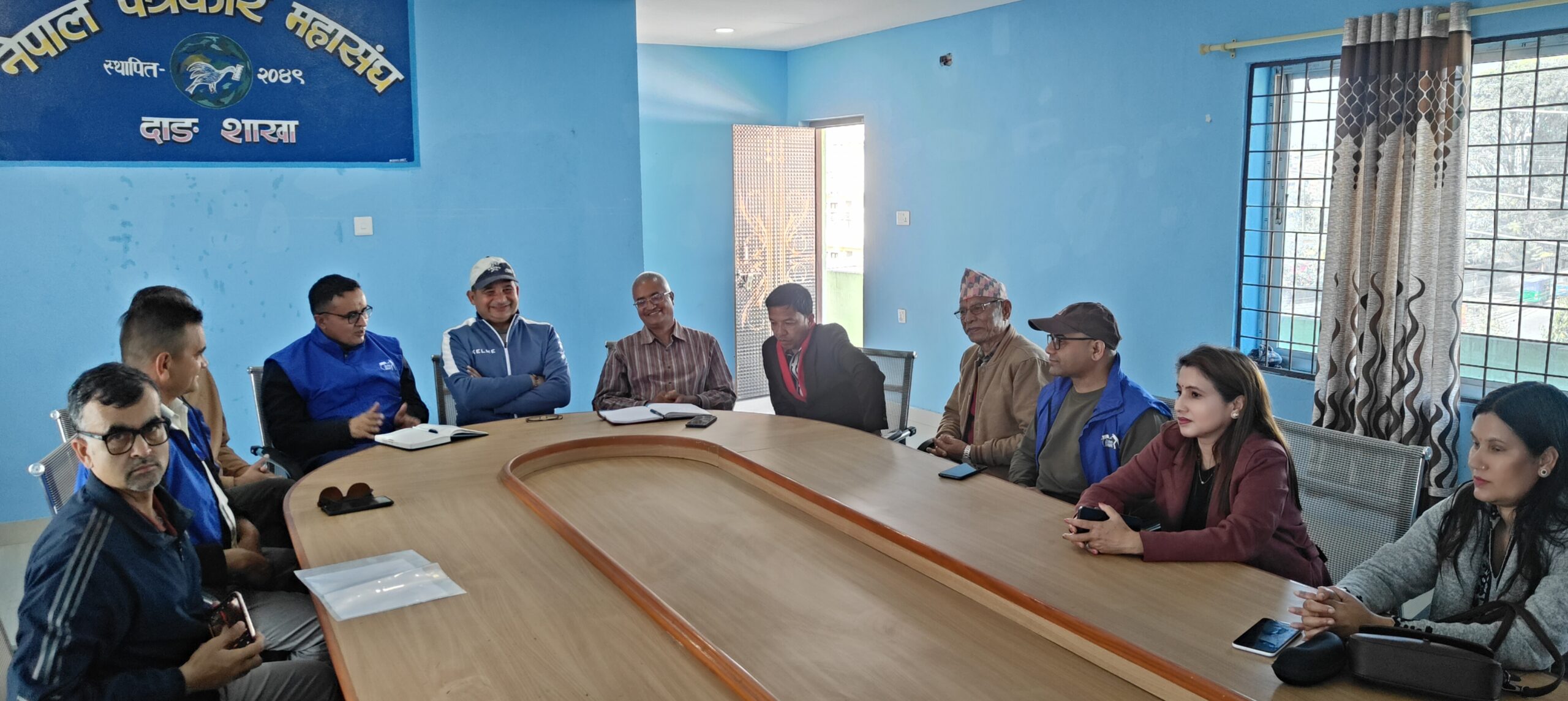 Speaking at the program, INSEC’s Information Officer Krishna Gautam noted that today’s elections have improved compared to the past and that INSEC is conducting regular monitoring to further enhance the process. “Since 1991, elections were often marked by clashes, conflicts among party workers, mutual bans, booth capture, and refusal to accept results if things went against a party,” Gautam said. “But now, that is not the case. There is a growing recognition of each other’s existence, and at least parties are bringing manifestos to the elections and engaging in discussions. This is a positive development.” However, he added that many areas still require improvement, and for this, the Election Commission, the government, and stakeholders need to be pressed to act.
On the occasion, Secretary of Civil Society Dang, Narayan Shrestha, said that citizens are still unable to cast their votes easily. He mentioned that voters are still being influenced through various means. “Voter education is very weak. How can voter education happen in a ward with thousands of voters if only one facilitator is sent for 15 days?” Shrestha asked. On one hand, voter education is lacking, and on the other, misinformation spreads through social media. How can voters then exercise their rights freely and independently?” He also highlighted that escaped prisoners and the presence of weapons pose challenges to the election process.
At the event, former central president of the Federation of Nepali Journalists (FNJ) Bipul Pokhrel, FNJ central secretary Savin Priyasan, former member of the Press Council Sharad Adhikari, election observer Prakash Gyawali, FNJ Dang president Santosh Subedi, President of the Women Human Rights Defenders Network Dang Anita Pokhrel, member of Human Rights Network Dang Binod KC, and PABSON Dang secretary Adim KC, among others, emphasized the importance of free and fear-free elections.